

A Buddha Above the City: When the High Line Turns Toward Stillness

New York is a city in constant motion. It thrives on noise, speed, and spectacle. Yet every so often, the city pauses—invited into stillness by a work of art that asks us to slow down, look closer, and remember. The High Line’s upcoming public sculpture does exactly that.
Rising 27 feet above Manhattan’s West Side, a monumental Buddha sculpture is set to replace the giant pigeon that previously occupied the High Line Plinth. Where once stood irony, humor, and playful disruption, there will now be quiet gravity. This shift is not simply a change of artwork—it is a transformation in tone, intention, and emotional register. It marks a moment where public art in New York leans away from spectacle and toward contemplation.
Positioned along one of the city’s most visited cultural corridors, the sculpture will loom gently over Tenth Avenue, its presence calm but undeniable. It does not shout. It does not entertain. Instead, it watches.

From Wit to Weight
The High Line has become one of the most influential stages for contemporary public art, known for installations that spark conversation and challenge expectations. The Plinth program, in particular, has embraced works that question monumentality—what deserves to be elevated, and why.
The pigeon that preceded this Buddha became a beloved symbol of urban wit: oversized, irreverent, and unmistakably New York. It celebrated the overlooked and the ordinary. Its success lay in its humor.
The Buddha arrives with a very different purpose.
This new work invites reflection rather than laughter. It carries history rather than irony. Its scale commands attention, but its message asks for quiet engagement. In a city saturated with images and information, this sculpture resists immediacy. It asks viewers to linger.
An Echo of a Lost Monument
The Buddha sculpture is inspired by the ancient Bamiyan Buddhas of Afghanistan—colossal sixth-century statues carved directly into cliff faces along the Silk Road. For centuries, they stood as symbols of cultural exchange, spiritual devotion, and artistic mastery. In 2001, they were deliberately destroyed, leaving behind empty niches in the rock and an irreversible loss to world heritage.
This High Line sculpture is not a reconstruction. It does not attempt to restore what was lost. Instead, it functions as an echo—a contemporary reflection shaped by memory, absence, and survival.
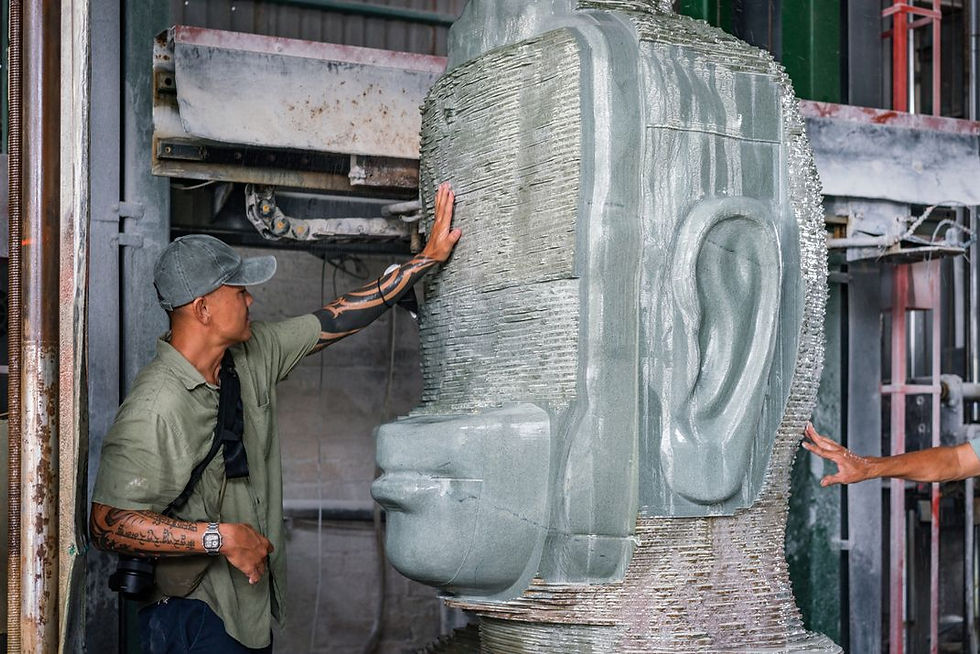
The figure appears intentionally incomplete. Portions of the body are fragmented, eroded, or missing entirely. These gaps are not flaws; they are essential to the work’s meaning. They speak to destruction without reenacting it. They acknowledge violence without sensationalizing it. The sculpture stands not as a replica, but as a witness.
In doing so, it reframes monumentality itself. Rather than glorifying permanence, it honors endurance.

Materials That Carry Memory
Every aspect of the sculpture has been shaped with intention. Carved from sandstone and internally reinforced, the work carries both physical weight and symbolic gravity. Yet its most powerful detail lies in its hands.
The Buddha’s hands are cast from recycled metal, including remnants of artillery and discarded weapons. These materials—once instruments of harm—have been transformed into gestures of compassion and fearlessness. The hands do not fully connect to the arms, leaving a deliberate space between stone and metal.
This visual pause is crucial. It represents rupture and repair, loss and possibility. It reminds us that healing is not seamless, and that history leaves marks that cannot—and should not—be erased.
By embedding the legacy of conflict directly into the sculpture’s form, the artwork collapses distance between past and present, between Afghanistan, Vietnam, and New York. It becomes a global object situated in a local space.
Stillness in a City of Motion
There is something profoundly striking about placing a meditative figure in the midst of Manhattan’s relentless pace. The High Line is a site of flow—tourists, commuters, conversations, cameras. Against this backdrop, the Buddha does not compete. It contrasts.
Its gaze does not seek attention, yet it holds it.
In this context, the sculpture becomes more than an artwork—it becomes a counterweight. A reminder that cities, like cultures, are shaped not only by what they build, but by what they choose to remember. It asks what role public art can play in an era marked by cultural erasure, political violence, and fractured histories.
The answer offered here is not didactic. It is emotional, spatial, and embodied.

Rethinking the Monument
Traditional monuments celebrate victory, power, and permanence. This Buddha does none of those things. Instead, it commemorates vulnerability, loss, and resilience. It stands not for dominance, but for survival.
This approach reflects a broader shift in how contemporary institutions are reimagining public monuments—not as static symbols of authority, but as living sites of dialogue. The High Line’s curatorial vision embraces this evolution, using the city itself as a platform for reflection.
By placing a fragmented Buddha above one of the world’s most dynamic urban environments, the work reframes what it means to honor history. It suggests that memory does not need to be whole to be powerful.
A Quiet Landmark
For eighteen months, the Buddha will occupy the High Line Plinth, watching the city move beneath it. Visitors may photograph it, pass it quickly, or stop and sit in its presence. Each interaction will be different. Each reading personal.
That is the strength of this work.
It does not instruct. It offers.
In a city defined by ambition and acceleration, the Buddha introduces a moment of pause—an invitation to reflect on what has been destroyed, what endures, and how art can carry meaning across borders and generations.
High above the streets, surrounded by steel, glass, and sky, the sculpture stands as a reminder that even in the loudest places, stillness can speak.
Comments