

ASCEND — The Evolution of Identity by Brian Higgins
- Art Dealer Street

- Oct 16, 2025
- 4 min read
Updated: Oct 17, 2025
In ASCEND — The Evolution of Identity, Brian Higgins turned Alessandro Berni Gallery into a field of momentum—city glow meeting Pacific light, color testing its limits until it became feeling. The paintings don’t sit politely; they move, loop, scrape, and breathe, letting earlier decisions shine through like memories you can’t quite file away. Stand close and the surface hums with risk; step back and you see a map of becoming. Higgins doesn’t explain identity—he stages it—inviting viewers to finish the thought with their own histories. The result is less a recap of images than a lived experience of change: high-voltage brushwork, quiet intervals, and the sudden recognition that transformation is the point.

The work of Brian Higgins : Motion you can stand inside
Higgins paints like someone listening closely—to the room, to past gestures, to the viewer who hasn’t arrived yet. Arcs and loops carry speed; translucent veils slow things down. You feel decisions being made in real time: a scrape that opens space, a glaze that softens heat, a line that holds the whole thing together. Palettes swing from neon dusk to tide-pool calm, but the shift never feels decorative. It reads like biography—compressed and abstracted—letting personal memory collide with shared atmosphere. Nothing is over-explained. Meaning shows up through the body first.






Identity as a verb
The show’s title is literal. Higgins treats identity not as a fixed label but as an action—layers added, revised, revealed. A band of ultramarine can change the whole painting’s weather. A graphite seam can reframe the story. This openness isn’t chaos; it’s trust. Trust that viewers bring their own histories. Trust that ambiguity can hold more truth than certainty. That’s why the work resists a single reading. It offers a place to notice how recognition happens—and how quickly it can shift.
The room as instrument
Ascend was built to be experienced at different speeds. From the entrance, the gallery read like a score—recurring gestures, chromatic echoes, pockets of silence that made the loud moments hit harder. Up close, texture took over: feathered edges, skin-thin washes, earlier marks breathing through. The room didn’t just present paintings; it tuned attention. People found themselves tracing a curve from one canvas to the next, as if following a phrase through a song.


Two live moments that clarified the thesis
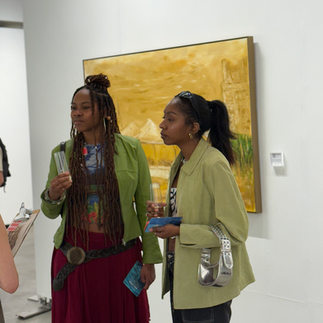
The opening reception (Oct 2) had the warmth of a homecoming and the edge of a premiere. With the artist present, conversations moved easily from composition to biography—how a West Coast light can haunt a New York night, how a single gesture can carry a season of thought. The live painting (Oct 4) made the show’s idea visible: identity in motion. Over hours, a blank field became an argued surface, then a balanced one—choices made, unmade, made again. You could watch doubt become direction. It was process, not performance, and it turned spectators into witnesses.


Why it mattered now
In a season crowded with certainty, Ascend argued for the value of in-between states—of images that leave room for the next decision, of viewers empowered to co-author meaning. It refused tidy narratives without collapsing into vagueness. Instead, it offered clarity of feeling: the pulse you get when a color lands, the calm after a well-placed pause, the private recognition that you’ve changed a little by looking.
Afterimage
Good shows change how you see the day after. Visitors spoke about carrying specific tones with them—an orange that made a subway car feel warmer, a quiet gray that turned a rainy block into a studio, a slip of blue that kept opening space in memory. That’s the gift here. Ascend doesn’t cling to the wall; it follows you out, reminding you that attention is creative, and that becoming is ongoing.

Ascend — The Evolution of Identity leaves its mark in the quiet after: the train ride home, the late-night scroll, the moment a color won’t leave you alone. Higgins doesn’t give answers so much as permission—to keep editing who you are, to trust that a next layer might change the whole picture. That’s the legacy of this show: process over pose, attention over explanation, becoming over being. Though the exhibition has closed, its charge is still active. If the work spoke to you, stay close—keep an eye on Alessandro Berni Gallery’s upcoming program, follow Brian Higgins’ next moves, and reach out if you want to continue the conversation. For press, interviews, or acquisition inquiries, contact art@alessandrobernigallery.com or +1 (845) 570-2632. The canvases may be off the walls, but the evolution they set in motion is very much ongoing.
You can learn more about Brian Higgins and Alessandro Berni Gallery via these links:
Brian Higgins Website: Brian Higgins Instagram: @brianhigginsart Artsy: @Brian Higgins
Alessandro Berni Gallery Website: Alessandro Berni Gallery Instagram: @alessandrobernigallery Artsy: Alessandro Berni Gallery
Explore the exhibition online at Artsy Viewing Room — ASCEND — The Evolution of Identity
Comments