

Inside the Studio: Andrea Bruder

Andrea Bruder’s practice moves against the speed of the world around her. In a time defined by immediacy, her work insists on something else entirely, slowness, presence, and attention. Through embroidery, she builds images not in moments, but over time, where each stitch becomes part of a larger, unfolding narrative.
Her work is not about spectacle. It is about intimacy. Figures emerge gradually, shaped by thread, repetition, and decision. Nothing is rushed. Nothing is accidental. The process itself becomes inseparable from the meaning, a quiet resistance to how we are used to seeing, consuming, and moving through images today.
At the center of her work is the human figure, not as an ideal, but as a carrier of identity, memory, and lived experience. Her subjects feel specific, grounded, and real, holding space for individuality while existing within shared moments of connection. There is a constant tension in her work between the personal and the collective, between solitude and community.
Her background in education and technology adds another layer to this practice. While her materials remain traditional, her thinking engages directly with contemporary questions, about attention, automation, and what it means to create something that cannot be replicated or accelerated.
In this Inside the Studio conversation, Bruder reflects on slowness, identity, community, and the quiet power of making by hand

Read on to learn more in an exclusive interview with Andrea Bruder:
You describe embroidery as a way of "returning to yourself." What did rediscovering this practice as an adult reveal about your relationship with creativity and personal expression?
Rediscovering embroidery as an adult felt less like learning something new and more like remembering something I'd always known. I think creativity had been living in me quietly for years—I just hadn't given it a room of its own. When I picked up the needle again, what surprised me most wasn't the technique, but the silence it created. I realized I had been moving through life at a pace that left very little space for personal expression. Embroidery gave me back that space. It revealed that I actually need to make things with my hands in order to think clearly—and that my relationship with creativity is deeply tied to slowness, to touch, to something tangible.

Your work embraces slowness—stitch by stitch—at a time when so much of our visual culture is immediate and digital. How does the slow rhythm of embroidery shape the way ideas and emotions unfold in your work?
The slowness isn't a limitation—it's the whole point. When you're working stitch by stitch, an image doesn't arrive all at once. It builds gradually, and so does your relationship with it. Sometimes an emotion I didn't even know I was carrying surfaces halfway through a piece. The rhythm forces a kind of honesty. You can't rush a feeling into shape. I think that's why my work ends up looking the way it does—not polished or resolved, but present. The time each piece requires is actually visible in the final work, even if you can't name it.

Many of your pieces portray diverse bodies and shared human experiences. What draws you to the human figure, and how do you approach representing identity and individuality through thread?
The human figure has always fascinated me because it carries so much without saying a word. Posture, clothing, the way someone occupies space—all of it communicates identity before a single word is spoken. In Diversidad, for example, I worked with twenty women from different parts of the world, and the challenge was to honor each one's particularity without reducing her to a symbol. Thread is actually a wonderful medium for this, because it forces you to make choices: which detail matters, which line defines a person. I'm not interested in idealized bodies or generic silhouettes. I want each figure to feel like someone specific—someone who exists, who has a story, even if I'm the only one who knows it.

Your artwork Amigas reflects themes of collective support and individuality within a group. How important is the idea of community in your practice, and how does it influence the stories you choose to tell?
Community is central to almost everything I make. I keep coming back to scenes of women together—not because I want to make a statement about feminism, but because that's the world I live in and observe most closely. What interests me is the tension between togetherness and individuality: how a group can hold space for each person's differences rather than flatten them. In Amigas, the circle is deliberate—there's no hierarchy, no single center of attention. Each woman claims her own presence. I think that reflects something real about the friendships I've seen and experienced. Community, at its best, doesn't ask you to disappear into it.

You often speak about embroidery as a form of resistance—against urgency, uniformity, and superficiality. How does working with traditional textile techniques allow you to challenge contemporary ways of seeing and consuming images?
We're used to images that arrive instantly and disappear just as fast. Embroidery refuses that logic entirely. Each piece takes weeks or months, and once it exists, it exists completely—no algorithm will replace it, no update will render it obsolete. I think there's something quietly radical about making something by hand in a world that keeps telling us automation is the answer to everything. I also work without mixed techniques or digital interventions—just thread and fabric, from the first stitch to the last. That's a choice. It means the image has a cost, a real human cost in time and attention, and I think viewers feel that even before they understand why. It slows them down too, even if just for a moment.

Your background includes education and technology, yet your artistic practice centers on handmade processes. How do these different parts of your life—education, technology, and craft—intersect in the way you think about art today?
People often find the combination surprising, but for me it makes complete sense. I've spent years thinking about how people learn, how technology shapes attention, and what gets lost when we move too fast. My embroidery practice is, in a way, a living answer to those questions. It's also where I process what I observe professionally. Working with AI in education, for instance, makes me think a lot about what humans do that machines can't—and hand embroidery sits right at that intersection. It's irreducibly human: imprecise, slow, emotionally loaded. I think my background in education actually made me a more intentional artist, because I'm always thinking about what an image communicates and to whom.

You exhibited your work at Clio Art Fair in September 2025 alongside independent artists from around the world. What was that experience like, and how did audiences respond to your textile-based work in that setting?
Clio was a genuinely moving experience. Being in a room with independent artists from so many different countries, each with a completely different practice, reminded me why I make art in the first place—it's one of the few languages that actually travels. What struck me most was how people interacted with the embroideries. At a fair, people move quickly, but textile work tends to stop them. They lean in, they look for the stitches, they want to understand how it was made. That moment of curiosity—when someone's relationship with the piece shifts from visual to almost tactile—is exactly what I hope for. Several people told me they hadn't expected to feel so drawn to something so quiet. That felt like the right kind of response.
Textile works by Andrea Bordando, Clio Art Fair 2025 Andrea Bordando booth, Clio Art Fair 2025 Visitors viewing Andrea Bordando’s work, Clio Art Fair 2025
Each embroidered piece requires patience, repetition, and attention to detail. During those long hours of stitching, what kind of internal dialogue or reflection tends to emerge?
It varies enormously. Sometimes the hours pass in something close to silence—not emptiness, but a kind of focused calm where the only thing that exists is the next stitch. Other times, a piece becomes a space where I work through something that's been sitting unresolved. I've noticed that repetition has a way of loosening thoughts that are otherwise hard to reach. Embroidery doesn't ask me to be smart or efficient—it just asks me to keep going. And in that space, things surface. Stories, memories, questions I hadn't thought to ask. I think that's why I call it an active meditation: the hands are busy, but the mind is quietly doing something else entirely.
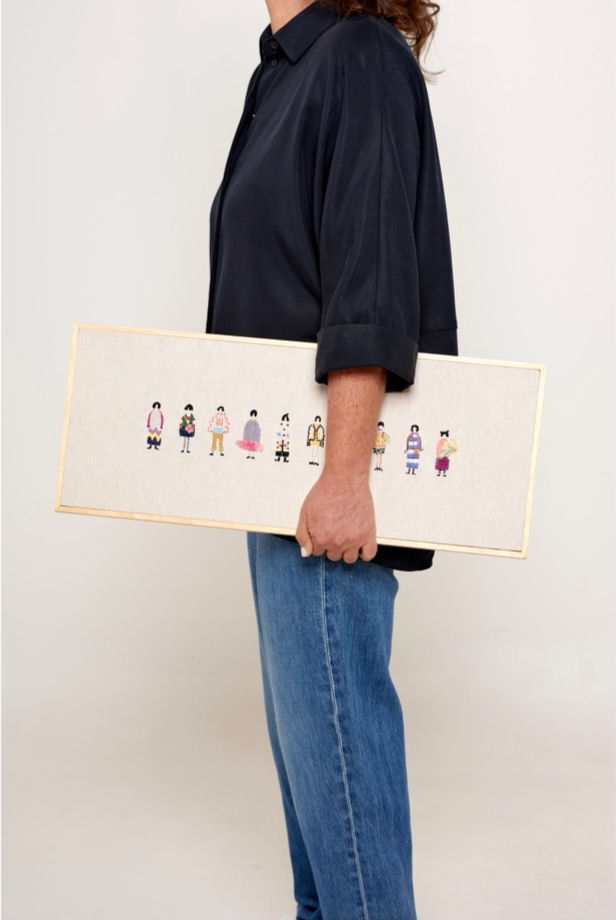
Bruder’s work does not compete with speed, it steps outside of it.
The longer you stay with her pieces, the more they begin to shift. What first appears as an image reveals itself as something else entirely, a record of time, attention, and presence. Each stitch carries a decision, a pause, a moment of consideration that cannot be undone or accelerated.
Her work asks something of the viewer. It resists quick consumption. It asks you to slow down, to look closely, to spend time with what is in front of you. And in doing so, it quietly disrupts the habits we’ve developed around images, the impulse to scroll, to glance, to move on.
There is also something deeply human in that resistance. In every thread, there is evidence of touch, of imperfection, of something made without shortcuts. In a world increasingly shaped by automation and immediacy, her work holds onto what cannot be replicated, time, care, and presence.
What remains is not just the image, but the experience of encountering it.
And perhaps more importantly, the space it creates, for reflection, for recognition, and for returning, even briefly, to a slower way of seeing.
You can learn more about Andrea Bruder and her work via these links: Instagram: @andrea.bordando
Comments