

Inside the Studio: Calicho

Updated: Jan 21
Calicho doesn’t paint to decorate the city — he paints to claim space within it.
Once trained to design structures, he now builds meaning through instinct, memory, and movement. His work speaks in symbols: whales that carry cities, portals born from darkness, wildlife that refuses to be tamed. Each mural feels less like an image and more like a message left behind for those who know what it means to arrive, to adapt, and to survive.
Rooted in migration and shaped by New York’s contradictions, Calicho’s practice is about belonging — not as an idea, but as a lived experience. His art meets people where they are: on sidewalks, walls, and in passing moments that quietly stay with you.
In this Inside the Studio conversation, Calicho opens up about identity, independence, fear, and faith — tracing the journey from architecture to art, from shadow to portal, and from arrival to purpose.

Read on to learn more in an exclusive interview with Calicho :
When you stepped away from architecture and chose the untamed freedom of art, what was the moment that made you say — “this is who I really am”?
Architecture taught me how to build walls; art taught me how to break them. The moment of truth came when I realized I was more interested in how people felt moving through a space than the blueprints themselves. Now, my life in art goes beyond the walls and the canvas. I want to generate experiences and lasting memories; my mission is to find and create moments that serve as a stamp of this generation.
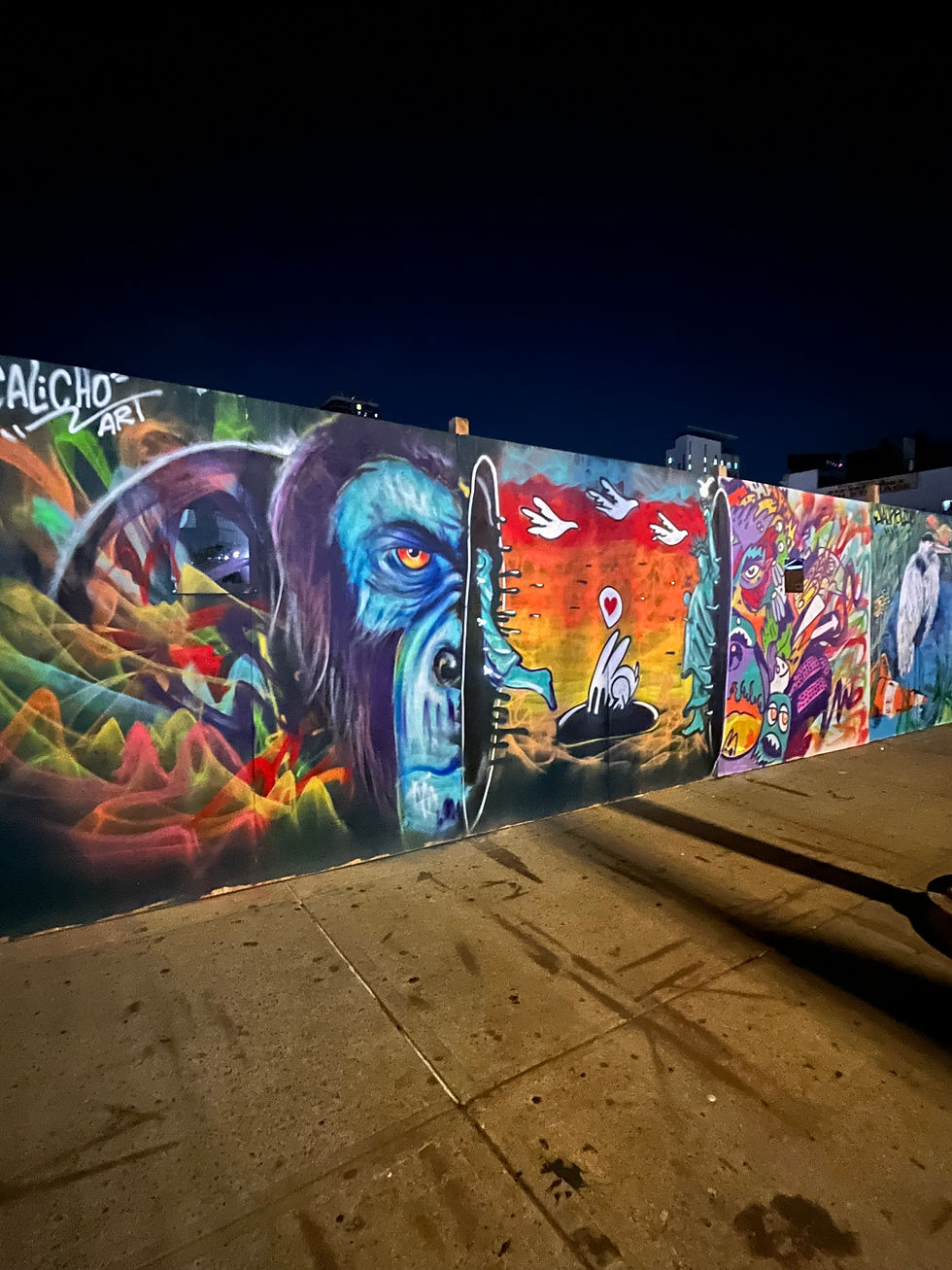
Your four elements — stripes, wildlife, doodles, and portals — feel like a personal language. If each one could speak, what part of your story would it tell about you?
These elements are my vocabulary. I use stripes for structure and wildlife for instinct. However, you will start to see more bunnies and elements that feel "out of context." I am moving toward a style of surrealism and visual oxymorons—using the unexpected to challenge the viewer’s reality. It’s about creating a portal to a world where the impossible feels natural.

You paint migration, survival, and hope in a city that can be both brutal and magical — what do you want immigrants walking past your murals to feel in their hearts?
I want them to feel seen and empowered. I want every immigrant to know they are not alone. Just like the whale that travels from South to North, you carry the essence of the place you came from with you. Because you carry that essence, you belong to the place where you live now. You aren't just a visitor; you are part of the new landscape.

The whale carrying New York on its back has become a symbol of strength. Who were the “whales” that carried you when you first arrived in this city — and who are you carrying now through your work?
When I first arrived, my "whales" were the people who supported my transition into this city. Initially, I only planned to stay for a few years. Now, seven years later, I am still learning and growing, and my dreams are bigger than ever. I’ve become a machine of ideas, and I’m constantly working to create new art that truly represents the heart and soul of New Yorkers.

In “Rebirth Darkness,” you show that every human is gold — even in shadow. What personal darkness did you have to conquer to create this vision of inclusivity?
This concept was born directly from my own loneliness and my darkest thoughts. It was through those shadows that the concept of "Portals" was born. To create this vision, I had to conquer my deepest fears of failure. Today, I have replaced those fears with a much stronger sense of faith in my journey and my craft.

At Clio Art Fair 2025, you stood among independent voices shaping the future of art. What did that moment prove to you about your place in the New York art world?
Standing there among independent voices proved that the "independent" path isn't just a choice—it’s a position of power. It confirmed that my voice belongs in the New York conversation. It showed me that I don't need to wait for permission to shape the future of art; I am already doing it by staying true to my own vision.

Your Flaco mural captured the spirit of a city that refuses to be caged. When you paint characters like Flaco, are you also painting hidden parts of yourself longing to fly?
Absolutely. Flaco was a mirror for all of us. When I painted him, I was painting my own escape from the "cage" of traditional career expectations. Like Flaco, we all have a wild spirit that New York tries to tame, but through art, we find the sky again. Every stroke of that mural was a reminder to myself to stay free.

Your art lives on walls, online, and in the minds of strangers who pause to look. What do you hope people discover about themselves when they meet your work for the first time?
I hope they discover their own curiosity. I want my art to make them look up and realize that they, too, are a blend of structure and chaos. I want them to leave with a memory—a "stamp" of this moment in time—and the realisation that they have the power to create their own "portals" out of any situation.

Calicho’s work lingers long after you’ve walked past it.
It doesn’t ask for attention — it earns it. Through strength, vulnerability, and imagination, his murals remind us that survival can be poetic, that independence is power, and that even in the heaviest moments, something luminous can emerge.
What Calicho leaves behind is not just paint on walls, but quiet reassurance: that you belong where you stand, that your story carries weight, and that transformation often begins the moment you dare to step through your own portal.
In a city that never stops moving, Calicho gives us pause — and in that pause, recognition.
You can learn more about Calicho and his work via these links:
Website: CalichoArt Instagram: @calichoart Facebook: @Calicho Art Artsy: @Calicho Arevalo
Comments