

Inside the Studio: Danae Nunez

Danae Nunez makes work that refuses to stay quiet.
Born and raised in Mexico City and now based in Orlando, Florida, Nunez brings together Mexican cultural imagery, immigrant experience, Latino identity, memory, resistance, and political critique. Her paintings, drawings, mixed-media works, and collages use bright colors, Otomi-inspired patterns, religious iconography, luchador masks, and cultural symbols not as decoration alone, but as a language of visibility.
Her work asks direct questions about who is seen, who is misunderstood, and who gets reduced to stereotype. In her hands, Mexican visual culture becomes both a personal archive and a public statement. It carries tenderness, humor, anger, grief, pride, and urgency.
Nunez’s practice moves between beauty and confrontation. Some works elevate everyday Latino figures to the level of saints or heroes. Others respond to immigration violence, racism, and political decisions with raw, direct force. Across all of them, the message remains clear: art can make people look, learn, and act.
In this week’s Inside the Studio, Danae Nunez reflects on Mexican heritage, the power of the luchador, resistance through image-making, her background in advertising, and what it means to create work that asks viewers to pay attention.

Read on to learn more in an exclusive interview with Danae Nunez:
Your practice brings together Mexican cultural imagery, Latino identity, and your own immigrant experience. How do you begin transforming personal history into visual language?
Mexican culture has an incredibly rich visual library, from color palettes to textiles, patterns, tiles, icons, and even people. Everything can be used as inspiration.
My goal with my work is to tap into that visual culture to make sense of who I am as a person, as an immigrant, and as a Mexican here in the U.S. I use a lot of metaphors within that visual language, like the luchador mask or religious iconography, to help bring the message across.
I also use more decorative elements that I think represent my culture and add vibrancy and decoration to the piece.

You often use traditional Mexican symbols, bright colors, Otomi patterns, and cultural metaphors in your work. What role does heritage play in the way you build an image?
Most of my work is centered around my personal heritage.
I grew up with a lot of Mexican visuals and crafts around me, and that is a lot of what I use in my art. I remember Otomi embroidered textiles at home and going to mercados where vendors wore traditional dress.
My mom always used very bright Mexican color palettes in her own art and had many books of Mexican art to take inspiration from. I use things that remind me of my own past, and then I also search for things whose meaning fits what I am trying to portray.

Your work challenges stereotypes around Mexican immigrants, Latinos, and women. How do you balance beauty, humor, critique, and resistance within the same artwork?
I think it really depends on the piece and what I am trying to portray.
Some pieces are a lot more graphic than others, and usually that is because I feel the message needs to be more raw and in your face, like La Matanza Continues or An Idiot’s Guide to Amerikkan Racism. Resistance and critique really drive those pieces.
Then there are other artworks, like Everyday Luchadora: La Muchacha or The Farmworker, where I am more focused on showcasing and elevating a person from our community to an almost saintly status.
For those works, I focus more on visual beauty because it has more importance there, but I think critique and resistance are just as present.

You have described art as a way to express an opinion and say something that needs to be said. What makes a subject urgent enough for you to turn it into a work of art?
It feels incredibly personal, to be honest. It usually tends to be something that evokes strong emotions in me.
Most of the time, it is something regarding immigration and the Latino community, but within that, there are issues that sometimes hit harder than others. When I learned about the kids who had died in ICE custody, that was very impactful. The same goes for the people who disappeared from Alligator Alcatraz.
Sometimes there are things you cannot get out of your head, or things that move you enough that you feel like you have to do something.
Other times, like with An Idiot’s Guide to Amerikkan Racism, it is about informing the public of something I think they should know. The Supreme Court decision that piece is based on should be more common knowledge, and people should be outraged. It sat with me for a while until I figured out a way to portray it.
So it varies piece by piece and subject by subject.

In your Everyday Luchadores series, the luchador becomes a metaphor for strength, survival, and everyday heroism. What drew you to this figure, and how does it reflect the Latino experience?
The luchador is part of Mexican culture in a way that everyone can clearly recognize and understand what it stands for. It signifies strength, power, and resilience.
What attracted me to it is that whether you are Mexican or not, you recognize it and can understand what it represents. Using it as a metaphor to showcase the Latino experience here in the U.S. felt like a simple visual way to get the point across.
The point is that these everyday people also display the same traits people associate with luchadores. It is a graphic element that gives more recognition to their struggle.

You work across painting, drawing, mixed media, collage, and advertising. How has your background as a creative director shaped the way you think about message, image, and audience?
My art has been greatly influenced by advertising.
A lot of what I do for work is try to get a message across in the most creative way possible, in a way that everyone can understand. A lot of my resistance work does the same thing.
It is about finding a creative wrapper for something that might seem unpalatable at first, but that you want your audience to take a message from.
They are both creative challenges, just with different intentions and results.

Your work has been shown at Clio Art Fair in New York, which focuses on independent artists and direct visibility. What was that experience like for you, and how did it feel to present your work in that setting?
It was a crazy experience and incredibly rewarding, especially with everything going on now.
To see my work, a Latina immigrant’s work, up in Times Square meant everything to me. It also affirmed that I am heading in the right direction, that my work and what I am trying to portray with it is working, and that other people see the meaning too.
It motivated me to keep going and keep growing as an artist.

Much of your recent work asks viewers not only to look, but to learn, question, and act. What do you hope people carry with them after encountering your art?
I hope people leave with a sense of urgency to at least pay attention to what is going on.
A lot of the members of the Latino community who are suffering do not have a platform to speak about the injustices they face, or they are too scared to do so. So many people are now tuned out. They think it is okay to ignore it or that it will go away.
But history has shown that it does not work that way.
I hope to confront people with those truths and lead them to act.
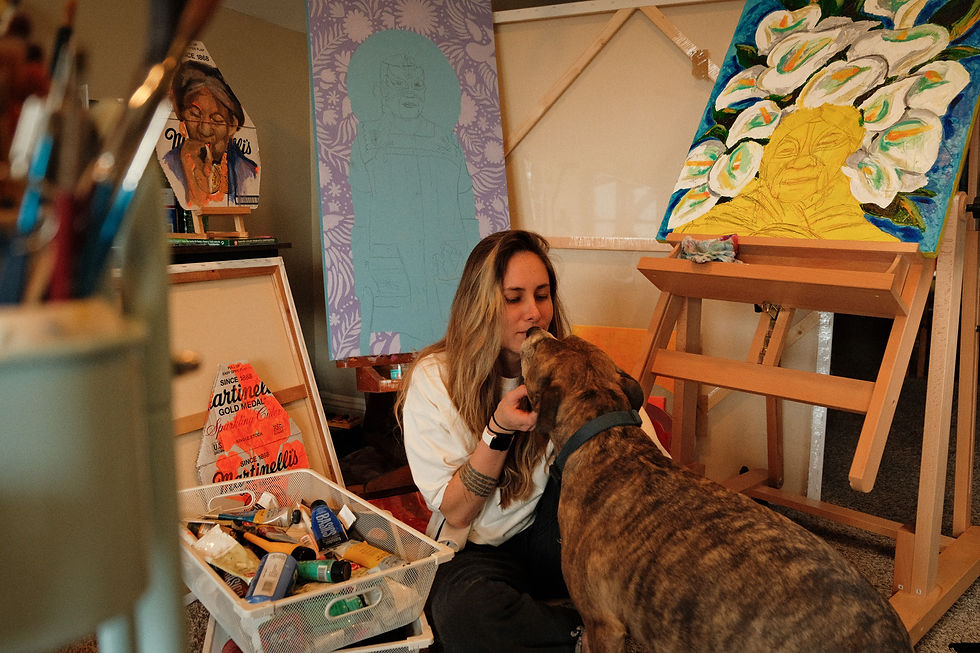
Danae Nunez’s work begins with image, but it moves quickly into responsibility.
Her practice uses the visual richness of Mexican culture not only to celebrate heritage, but to challenge how that heritage is misunderstood, flattened, or politicized. Bright colors, decorative patterns, religious references, luchador masks, and familiar cultural symbols become tools for both beauty and resistance.
What makes her work so urgent is the way it holds contradiction. It can be playful and serious, tender and confrontational, visually vibrant and politically sharp. It asks viewers to admire the surface, but not stop there.
Nunez understands that images have power. They can simplify, stereotype, erase, or distract. But they can also restore dignity, make history visible, and give urgency to stories that are too often ignored.
Through her paintings, mixed-media works, and resistance-driven visual language, she invites us to look harder at the world around us and at the people whose stories deserve more than silence.
Her work does not ask for passive viewing. It asks for attention. It asks for memory. It asks for action.
You can learn more about Danae Nunez and her work via these links: Website: @Danae Nunez Instagram: @_mocosa
Comments