

Inside the Studio: Denny Theocharakis

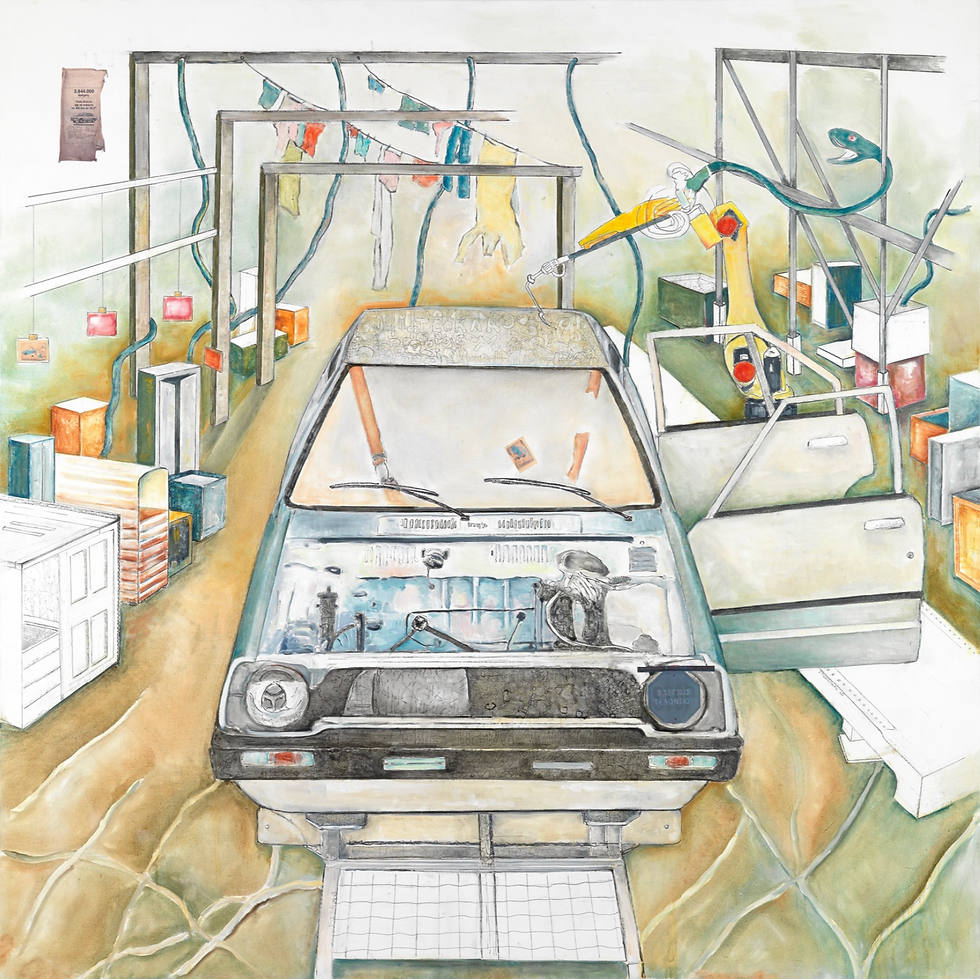
Denny Theocharakis paints from the charged space between memory, movement, and material trace. In Memories From A Family Car Factory, she returns to the industrial environment of her childhood — a world of production lines, repeated gestures, bare car bodies, and the quiet afterlife of a place once full of activity.
But her work does not remain fixed in the past. The factory becomes a site of transformation, where personal memory dissolves into abstraction, abandonment, and imagined routes. Through blueprints, rice papers, textures, and layered images, Theocharakis turns memory into something physical — something that can be touched, resisted, and reimagined.
In this Inside the Studio conversation, Theocharakis reflects on childhood, travel, industrial rhythm, material experimentation, and what it means to present this deeply personal body of work in New York.

Read on to learn more in an exclusive interview with Denny Theocharakis:
Memories From A Family Car Factory draws from your childhood environment. What is one memory from the factory that continues to stay with you when you paint?
There are many different images. Actually, two of them dominate my mind almost simultaneously. One is the sight of the cars, still just bare car bodies, moving one behind the other along the production lines, while the workers repeat the same movements with speed and precision.
Yet as I paint, that wondrous scene dissolves, giving way to images of abandonment and glories of the past that are gone forever.
Your travels and observations of everyday life around the world appear throughout your work. How do you recognize when a moment from travel is something you want to bring into your art?
I find your question truly fascinating. Wherever I go, I am drawn to observing the world around me and capturing moments that resonate. While traveling, I remain fully alert — stopping in villages, talking with people, and feeling both honored and delighted when they welcome me into their homes. These encounters are unique experiences that I strive to translate into my painting.
Beyond my journeys, I constantly revisit my photographic archive, reliving past experiences and often blending different images together to create entirely new realities. It is in this interplay between memory, observation, and imagination that my art comes to life.

Many of the works in this series feel like maps of shifting paths and connections. What does the idea of multiple possible routes mean to you personally and creatively?
The idea of multiple possible routes resonates deeply with me, both personally and creatively. Life itself is full of unexpected turns, encounters, and decisions, and I see my work as a reflection of that fluidity.
Each painting is like a map of choices, experiences, and memories — sometimes clear, sometimes overlapping or diverging — and exploring these paths allows me to navigate my own experiences while imagining new possibilities.
Creatively, it gives me freedom to combine, transform, and connect images in ways that might not exist in reality, turning uncertainty and multiplicity into a source of inspiration.

The factory carried its own tools, sounds, and gestures. In what ways do those industrial “rhythms” influence your brushwork and composition today?
The factory’s tools, sounds, and gestures left a lasting mark on me, shaping the rhythms of my brushwork. They spark new creations and, depending on the paper, I enjoy shifting themes and styles, letting the memory of those precise, repetitive movements inspire fresh ideas.

You describe your style as constantly evolving. What pushes you to keep changing, experimenting, and not settling into one visual style?
My style is constantly evolving because I am drawn to exploration and experimentation. Each new experience, observation, or memory opens up possibilities that I feel compelled to follow rather than repeat.
I enjoy shifting themes, experimenting with different materials and techniques, and letting my work respond to the moment. This continual change keeps my practice alive, challenges me creatively, and allows me to discover unexpected paths in both subject and form.

Materials and textures play a strong role in this series. How do you choose what materials to work with, and what role does touch or surface play in creating memory?
Materials and textures play a central role in my work because they carry a sensory and emotional weight beyond the visual. The paper I use greatly influences the type of painting I create.
In this exhibition, most of the papers I worked with are either blueprints from the factory or rice papers I found abandoned there. Depending on the surface, I experiment to see which material will give me the best result.
The texture and resistance of each paper shape my gestures, allowing my touch to become a way of connecting with memories and turning past experiences into the artwork itself.

What does it mean to you to present this body of work at Alessandro Berni Gallery in New York, and how does the context of the gallery or city influence how you imagine viewers will engage with the exhibition?
Presenting this body of work at Alessandro Berni Gallery in New York is especially meaningful for me, as New York has long been a city where I dreamed of showing my art.
My professor at art school always told me that a true artist must exhibit their work and give people the opportunity to see new art. After all, the art of each era reflects the concerns of contemporary society.
Alessandro Berni Gallery, with its thoughtful curatorial approach and engagement with an international audience, offers the perfect context for this work. New York is a major art center, with a wide audience genuinely interested in art, and this inspires me deeply as I imagine viewers engaging with the exhibition.

As you continue to travel and collect new impressions, what remains constant for you — the part of your practice that always feels like “home”?
As I continue to travel and gather new impressions, what remains constant in my practice is the connection to memory and the act of observing the world closely.
No matter where I am or what materials I use, I always return to the process of capturing moments, gestures, and sensations that resonate with me. This focus — translating experiences and memories into painting — feels like “home,” providing a stable foundation amid experimentation and change.

Theocharakis’ work holds memory in motion. The factory appears not as a fixed place, but as a living source of rhythm, texture, and transformation. What begins with childhood recollection opens into something wider — a meditation on time, travel, labor, and the fragile beauty of places that continue to shape us long after they have changed.
Through found papers, layered images, and shifting visual paths, Memories From A Family Car Factory becomes both personal archive and emotional landscape. In Theocharakis’ hands, memory is not only remembered. It is rebuilt, touched, and painted into being.
You can learn more about Denny Theocharakis and her work via these links: Website: Denny Theocharakis Instagram: @dennytheo_art Artsy: Denny Theocharakis
Comments