

Inside the Studio: Efrain “NOMAD” Martinez

Efrain “NOMAD” Martinez is a New York City–based artist whose work moves through dark tones, vibrant color, mythology, horror, religion, and personal symbolism. His practice is rooted in independent exploration, emotional processing, and a desire to create images that feel both otherworldly and deeply human.
Working outside traditional academic pathways, NOMAD has developed a visual language shaped by intuition, personal history, cultural memory, and the stories he carries from growing up in Queens. His works often feature monsters, animal hybrids, sacred figures, and symbolic characters that become vessels for emotion, trauma, identity, and transformation.
In this week’s Inside the Studio, NOMAD speaks with Art Dealer Street about his name, the Astral Plane, his Colombian heritage, the role of monsters in his work, and the difficult but necessary process of presenting art to the world.

Read on to learn more in an exclusive interview with Efrain “NOMAD” Martinez:
Your artist name, NOMAD, carries a strong sense of movement, identity, and self-invention. How did this name come to represent you and the world you create through your art?
I chose the name NOMAD because I feel I have traveled through many different worlds of taste and interest, especially when I think about where I was when I first started to think about art.
I used to call myself “INFAMOUS MONSTER.” Back then, the goal was to become a graffiti artist. But the more experience you gain and the more you learn, the more you grow as an artist and as a person.
From admiring artists like Caravaggio, Dalí, and Goya, to Jim Lee, Frank Miller, Jack Kirby, and graffiti artists like Mear One, El Mac, and Sam Flores, I have traveled the spectrum like a NOMAD.

You describe your work as a way of bringing visions and stories from the Astral Plane into the physical world. What does the Astral Plane mean to you creatively, and how does it shape your imagery?
To me, the Astral Plane is the place between imagination and the spiritual. It is where most of my ideas and inspiration come from, like messages and images fed to me from some higher being.
The Greeks refer to it as the Muse. The idea is sent to me, and then I have to use my imagination to form it and give it shape.
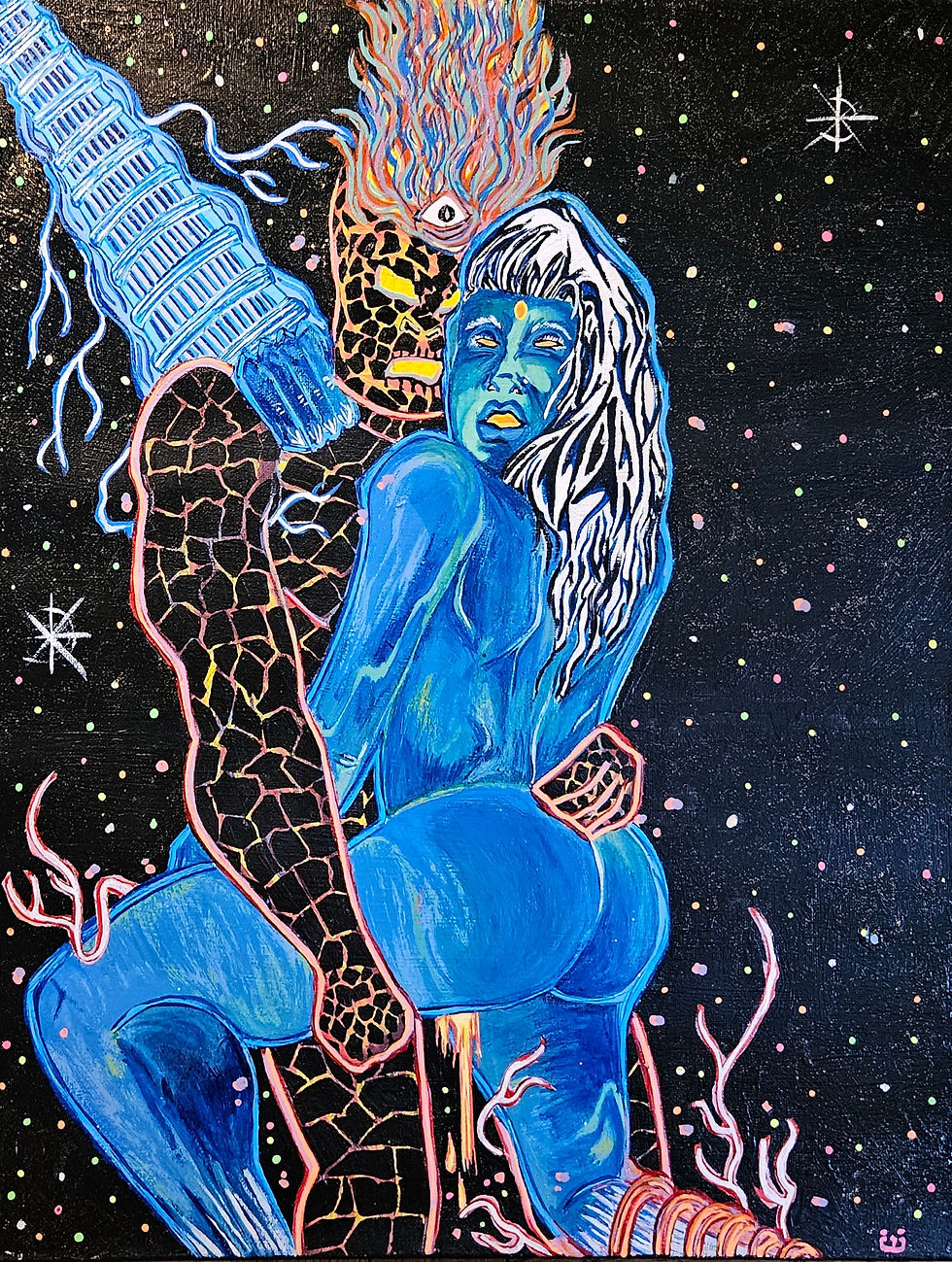
Your work often combines dark tones, dystopian visuals, horror, mythology, religion, and vibrant color. How do you balance darkness and beauty within a single composition?
I give most of the credit to my mother.
When I was in high school, I did a lot of drawing and sketching. I only used black on white paper. I never touched color. I would express how I felt in my drawings, and naturally, she would complain that it was too dark and that I should draw nicer things with color.
So when I decided to experiment with paint, I decided to take her advice and use color. It wasn’t until I learned about the color wheel that I really embraced it.
Although the paintings and drawings might be vibrant with many different colors, the subject matter may still be of a darker nature. Like most cases in nature, the most beautiful creatures are sometimes the most dangerous. The balance is there.

You are a self-taught artist who developed your style outside of traditional academic pathways. How has independent learning shaped your confidence, creative freedom, and visual language?
This is a complicated question for me.
The fact that I am self-taught does give me the ability to create with a look that has not been seen yet. But with that being said, when I see other artists present their work next to mine, I can see the difference in proper technique and use of paint.
It makes me feel insecure and doubtful, especially if I like that artist’s work. After all, the reason my art looks the way it does is because I am not trained.
The lack of knowledge forces me to be creative in my execution. I am never satisfied with my work. It can always be done better.

Growing up in Queens, surrounded by many cultures, had a strong influence on your worldview. How does your New York upbringing and Colombian heritage continue to appear in your work?
Queens is the melting pot of the world, and you can find a new nationality on every block. I grew up learning about different cultures and their traditions.
I enjoy it because everyone has their own mythology and stories. But at the root of those stories, everyone is telling the same one and expressing the same ideas and feelings. To me, that is fascinating.
My latest series of paintings is inspired by Colombian mythology and iconography. It was a good way of sharing my culture with others, expressing my love for my culture, and a good reason to paint monsters.

Your work often uses monsters, animal hybrids, sacred figures, historical references, and symbolic imagery. What draws you to these characters, and how do they help you express human emotion?
I think it has to do with the way I was brought up as a child.
My parents were religious, and I was no stranger to church and religion. I also grew up learning about historical figures doing great deeds that I found inspiring.
I like monsters. Due to childhood trauma, I usually see myself in the monsters. I can relate and sympathize with them. Sometimes I can even understand their point of view.
Each monster is a representation of trauma. They are avatars for my feelings at the moment.

You have spoken about art as both therapeutic and a way to leave your mark in the world. How does creating help you process personal experiences, and what do you hope viewers feel when they encounter your work?
The best way I can explain the therapeutic process is this: whatever I am dealing with or feeling at the moment, I use art as a way of filtering the experience.
I create avatars that represent the emotions, in a scene where they are forced to deal with the situation that I cannot. In the process of making this, in some ways, it is me dealing with the situation and leaving all that energy and emotion in the art.
The only thing I want when people look at my art is for them to feel something. It doesn’t have to be good or bad. I just want them to be overwhelmed with feeling.
You participated in Clio Art Fair alongside independent artists from different backgrounds. What was that experience like for you, and how did it feel to present your work within the Clio Art Fair setting?
I found the experience to be difficult because I don’t think I belong there. To be fair, I feel this way every time I am presenting art. I still have not been able to find my audience.
It was interesting to meet the other artists and talk to them, and some of the performances were interesting to witness.
But I guess this is something I have to work on, and I need to practice being more open when it comes to the art community.

Efrain “NOMAD” Martinez’s work is built from movement, memory, mythology, and emotional intensity. His art does not seek comfort or easy beauty. Instead, it asks viewers to enter a space where darkness, color, trauma, spirituality, and imagination all exist together.
Through monsters, symbols, and visions from what he calls the Astral Plane, NOMAD continues to build a world that is deeply personal, culturally layered, and emotionally charged.
You can learn more about Atom Hovhanesyan and his work via these links: Website: Atom Hovhanesyan Instagram: @artbyatomhov
Comments