

Inside the Studio: Kenneth Walker

Kenneth Walker’s paintings invite viewers into a world where color, texture, and symbol coalesce into profound expressions of emotion and experience. With a background rooted in the legacy of abstract expressionism, his practice blends action painting with color field techniques, layered with meaning both personal and universal. Rather than painting for the marketplace, Walker paints for memory, legacy, and healing—his works aren’t sold but gifted, donated, or passed on to family. In this studio visit, he opens up about his evolving process, the power of hidden messages, and the quiet satisfaction of making art that speaks when words fall short.

Read on to learn more in an exclusive interview with Kenneth Walker :
1. Your process involves layering, scraping, and sanding until the canvas “speaks” to you. Could you walk us through what this dialogue with the work feels like, and how you recognize when you’ve uncovered that hidden message?
I typically follow one of two processes. Either I begin with an idea in mind, or I let the canvas guide me. I start with a dark base color and gradually layer others, often scraping or sanding them back. Through this, patterns and paths begin to emerge—sometimes even a symbol or image that speaks to me. That’s when I know I’ve found the message. The final step is always a bold, bright “pop” to establish the focal point.

2. You balance color field and action painting, sometimes creating contradictions on the canvas. What draws you to this tension, and how does it reflect your intentions?
I’ve always been inspired by the abstract expressionists—Pollock, Kline, Rothko, Still. Their work taught me that both dynamic motion and stillness hold emotional power. I combine both approaches not to create conflict, but to pose a question to the viewer. In Broken Promises II, for example, I placed a circle symbolizing unity beside a Chinese character for “broken”—a contradiction that invites contemplation. I want the viewer to wonder what I’m trying to say.

3. Hidden symbols and messages play a central role in your composition. What do you hope someone discovers or feels when they first engage with your work?
I want to challenge the viewer to figure out what I’m trying to communicate. I use both symbols and color to encode meaning. In Rocker, the rocking chair symbolizes aging and reflection. I paired it with yellows, oranges, and reds to evoke memory and time. It’s about helping the viewer feel something they might not have expected—something deeply human.

4. Can you share a moment when scraping back layers revealed something unexpected or shifted your original vision during the process?
Absolutely. I once set out to paint an aerial view of my neighborhood—trees, houses, a beach. Inspired by Jean Paul Riopelle, I tried to mimic that aesthetic, but it turned out terribly. I began sanding it back layer by layer, and something entirely different appeared. I added bright colors for focus and glazed the whole thing in gold. Though I couldn’t name it, the final result—Untitled—was beautiful and far better than my original plan.
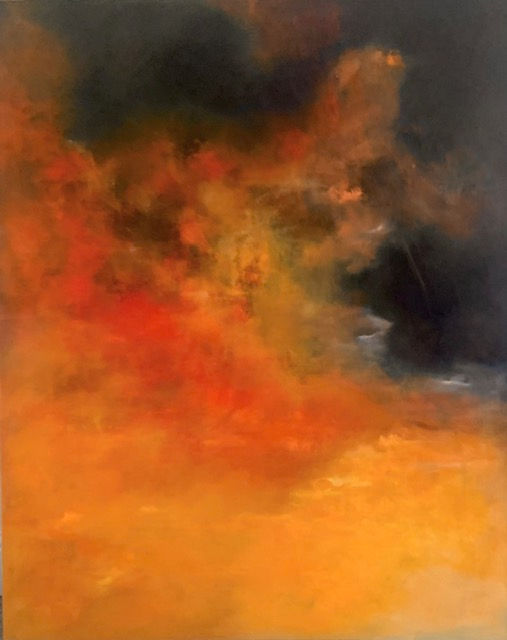
5. When you set out with a symbolic objective, how do you balance that intention with spontaneity as the piece unfolds?
That balance usually comes toward the end. I might spend 60 hours on a painting and still feel unsatisfied. That’s when I step away—sometimes for days, sometimes for a year. Then one night, I’ll return to it with a glass of wine and try something spontaneous, even crazy. Ironically, those last ten minutes often make the piece whole. That’s when it becomes my best work.
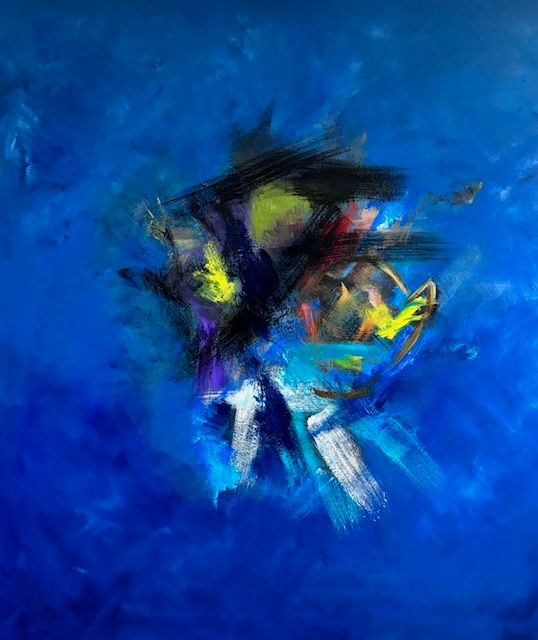
6. You describe colors as defining the soul and personality. How do you choose your palette for a new work, and what emotions or character traits are you aiming to express?
Each color has a soul. I choose based on what needs to be expressed—warmth, nostalgia, anxiety, or hope. I don’t always know what I’m trying to say until I start laying down paint. But I trust that the colors will speak for me, even when I can’t put it into words.

7. For collectors and audiences new to your art, what essential idea or feeling do you hope they take away from your paintings?
I want them to leave thinking, “This guy is trying to tell us something.” That’s all. I don’t paint for decoration or commercial appeal. I don’t sell my work or run a website. My art goes to family, friends, or charities—mostly for cancer research or religious organizations. It’s about meaning, not money.

Kenneth Walker didn’t set out to be a professional artist. He began painting six years ago to document his values, beliefs, and inner world—something to pass on to his children and grandchildren. What started as a personal practice has grown into a body of over 80 paintings and exhibitions across London, California, Miami, and New York. But at its core, Walker’s art remains a quiet, powerful act of legacy. With every brushstroke, symbol, and hidden message, he invites us to look deeper—not just into the canvas, but into ourselves.
You can learn more about Kenneth Walker and his work via these links: Artsy: @Kenneth Walker
Comments