

Inside the Studio: Kirsten Bowen

Kirsten Bowen paints the kind of images that make you look twice.
From across the room, her surfaces feel photographic — crisp reflections, quiet horizons, water so still it seems touchable. But step closer and something shifts. Words surface. Texture rises. Plaster, pigment, poetry, and memory collide. What first feels like realism slowly becomes something more layered, more intimate — part landscape, part language, part lived experience.
Her practice moves between precision and feeling, craftsmanship and intuition. Whether capturing the shimmer of light on water or embedding handwritten poetry into textured plaster, Bowen isn’t simply recreating what she sees — she’s translating what it feels like to be there. To float. To breathe. To remember.
Across decades, her path has wound through textile design, murals, gallery ownership, teaching herself new techniques, and developing what she calls her own “Venetian Fresco” process — a distinctive blend of underpainting, text, and surface that transforms paintings into quiet conversations.
In this Inside the Studio conversation, Bowen reflects on pattern, poetry, swimming, abstraction, and the slow evolution of a practice that continues to surprise her.

Read on to learn more in an exclusive interview with Kirsten Bowen :
Your work often creates that immediate “wow” moment—viewers sometimes think they’re looking at a photograph before realizing it’s a painting. When you’re in the studio, what are you most focused on: precision, emotion, or the space where the two meet?
Thanks for giving me a “wow” regarding my photorealistic water paintings — the answer would be precision. That’s the craftsmanship part of the job. But when I’m out on the water, I’m waiting for the perfect combination of light, wind, and reflection to capture the emotion of awe and tranquility as I compose the initial photograph.

You’ve moved fluidly between design, textiles, murals, gallery ownership, and full-time studio practice. Looking back, how have these different chapters shaped the way you approach painting today?
My art school portfolio emphasized my love of pattern. That led me to carpet design, textile design, and faux painting. My text-based paintings and abstracts also emphasize pattern, so that thread has always stayed with me.
Owning a gallery and curating exhibits taught me to think about how art lives in a space — how it feels to be in a room surrounded by it. That awareness still shapes how I build my work today.
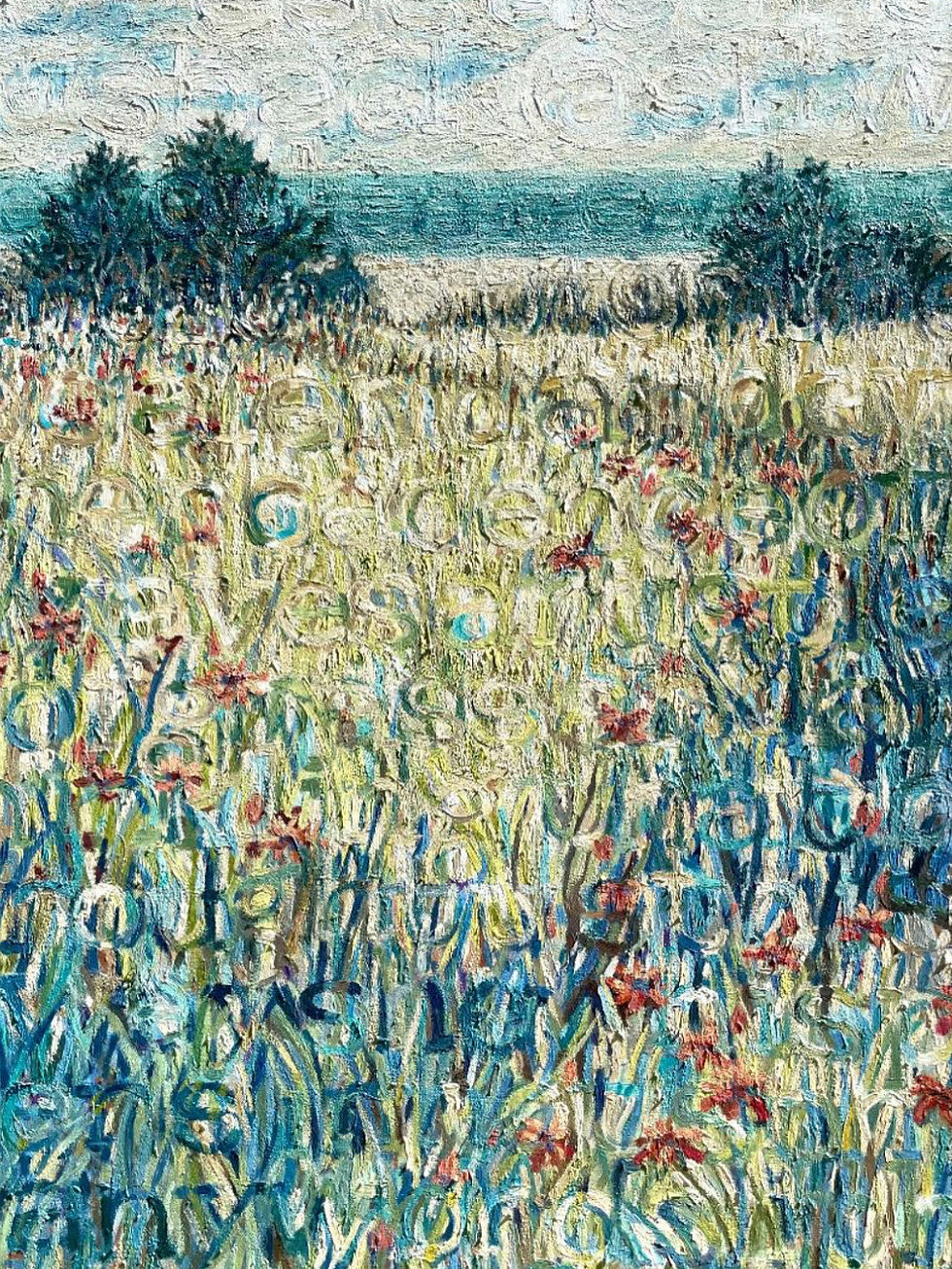
Water, movement, and navigation recur throughout your work—from buoys and reflections to waves and markers. What continues to draw you to these motifs, and how personal are these landscapes for you?
Swimming has been a great love my whole life. My water paintings capture the feeling of being immersed because of the low camera perspective. It’s less about observing water and more about being inside it.

Your “Venetian Fresco” technique blends text, texture, and layered meaning. Could you share how a painting builds from the first plaster layer to the final surface?
I start with an underpainting using loose colors and imagery, then find the words that belong to the piece.
For years, I quoted other poets, but eventually I began writing my own poetry. It happened organically — after studying poetry for so long, the words started coming from me. A gallery once encouraged me to finally take credit for them.
It’s a strange way to become a poet, but my father loved writing poetry, so in a way it feels like I’m helping fulfill something he dreamed about too.

Language plays a strong role in your paintings—lyrics, poetry, prayers, everyday text. How do you decide what words belong, and when they stay readable or drift into abstraction?
A collector once described my process as “reverse ekphrasis.” After laying in the underpainting, I stand back and observe what the piece makes me feel. Then I write.
I usually begin with five haiku to find the emotional tone. From there, the text evolves naturally.
Legibility depends on the composition. In complex areas, the words might dissolve into texture. In open spaces like the sky, they’re often clearer, guiding the viewer in. Sometimes I even move a word purely as a design element.
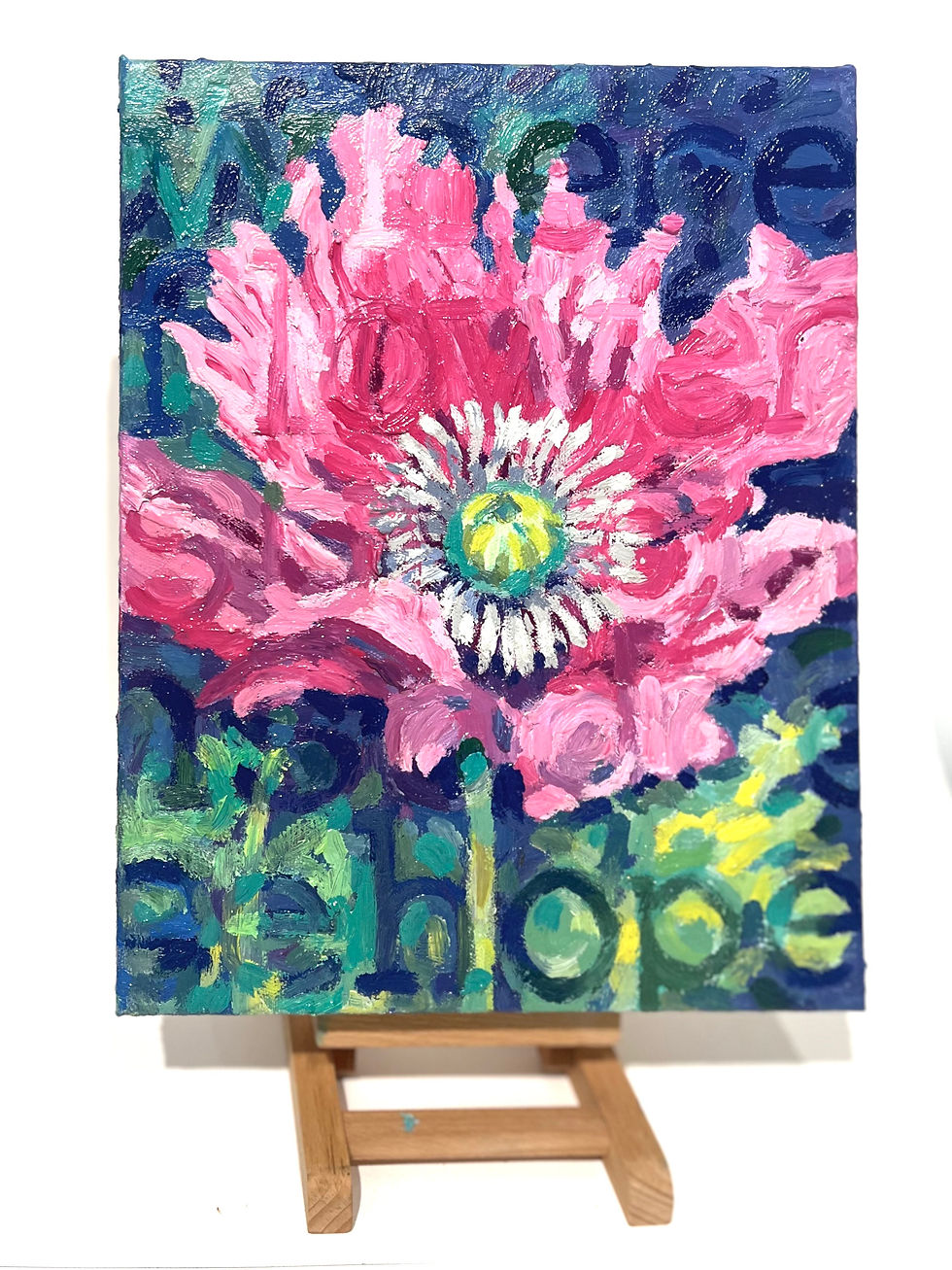
Your work has evolved from photorealistic nautical scenes to abstract landscapes and, more recently, the human figure. What excites you about this evolution, and what challenges have surprised you?
It actually began with color-field text paintings that accidentally looked like landscapes. A blue painting with a brown band suddenly felt like a watery horizon — that’s when imagery entered my work.
But I realized not every image worked well with text. Sometimes the words flattened the water or changed the feeling entirely. That pushed me to explore new directions.
During the pandemic especially, I wanted to escape — to swim away, to travel through paint. That desire led me toward new styles and new freedom.

You exhibited with Clio Art Fair in May 2025 alongside many independent voices. How did that environment shape the way audiences engaged with your work?
The Clio experience was such a needed interaction with other artists. The energy was incredible — especially on VIP night. There were so many people I didn’t even know where to stand to stay out of the way.
What stood out most was how long people stayed with the work. They really stared. And my favorite compliment kept coming back: “I’ve never seen anything like it before.”

After decades of exhibiting and constantly teaching yourself new techniques, what keeps you curious today—and what are you hoping to explore next?
Right after Clio, I began exploring more abstraction. I kept wondering what my voice would look like if I went fully non-representational.
Another artist at the fair encouraged me to experiment more freely. Like poetry, abstraction has no right or wrong — it’s almost like doodling, expressing personality without an agenda.
Right now, I’m drawn to brighter colors, fluid shapes, and work that feels lighter. I think we all need art that offers a positive, open space to breathe.

Kirsten Bowen’s paintings don’t rush you.
They ask you to slow down — to notice the shimmer inside a brushstroke, the quiet weight of a word, the memory hidden in a horizon line. Precision draws you in, but emotion is what lingers.
Whether through water, text, or abstraction, her work becomes less about what we’re looking at and more about what we’re feeling. A moment of stillness. A breath. The sensation of floating just beneath the surface.
And sometimes, that quiet recognition is the most powerful “wow” of all.
You can learn more about Kirsten Bowen and her work via these links:
Website: Kirsten Bowen Instagram: @kirstenswansonbowen Artsy: @Kirsten Bowen
Comments