

Inside the Studio: Raisa Nosova

Some stories do not ask to be told — they insist.
For Raisa Nosova, art begins where language fails. Her practice is built from separation, displacement, motherhood, and memory — not as themes, but as lived realities that continue to shape the body and mind. Drawing first became a survival tool, then a method of excavation: a way to face trauma without simplifying it, and to give form to emotions that refuse to stay quiet.
Working across painting, drawing, sculpture, performance, and public space, Nosova creates from a place of radical honesty. Her work does not resolve pain — it studies it, sits with it, and exposes its long shadows. In doing so, she invites viewers into a space where vulnerability is not softened, but shared.
In this Inside the Studio conversation, Nosova reflects on early separation, cultural displacement, motherhood, political responsibility, and the invisible labor carried by women — tracing how personal history becomes visual language, and how endurance becomes form.
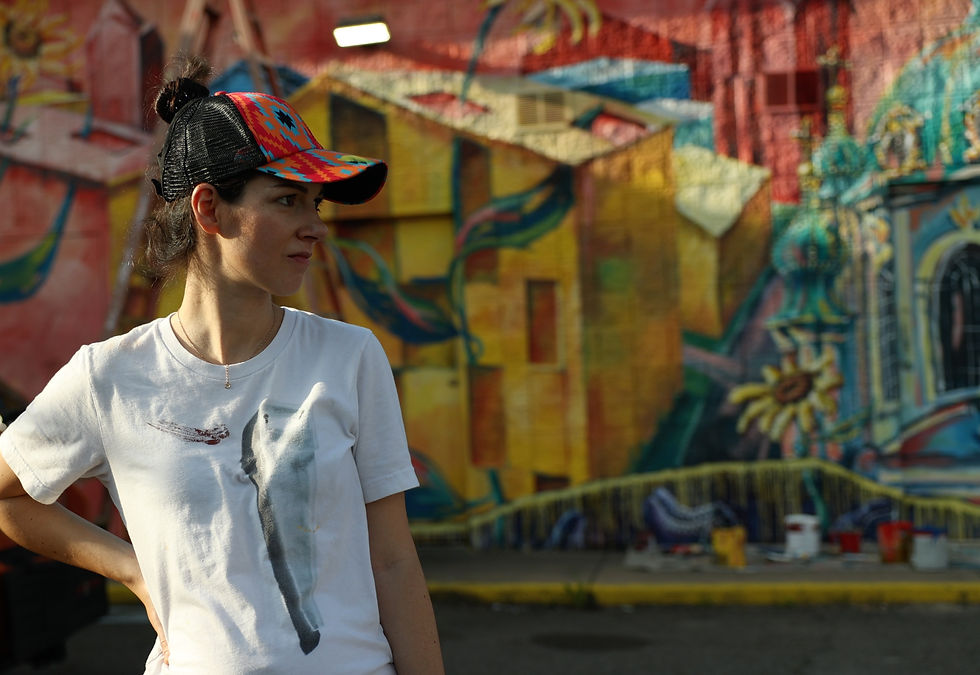
Read on to learn more in an exclusive interview with Raisa Nosova :
Your work often reveals what is usually concealed—pain, memory, and emotional endurance. How did you arrive at a point in your artistic journey where confronting trauma became central to your visual language?
At the age of nine, I was separated from my mother for what was supposed to be a month, but became a year and a half, during the process of our immigration to the United States. I did not get to say a proper goodbye to her as she boarded the train in a hurry, nor did I know in advance how long the separation would last. It was not easy to keep in touch. We had scheduled phone calls about once a week, for which we had to walk about a mile to reach the phone.
During that time, I turned heavily to drawing. It helped me cope with the void, with the weight of dreams in which she returned home and embraced me, and with emotions I could not yet name or understand.
After that year and a half, as I was immigrating to the U.S. myself, I had to part with my grandparents, cousins with whom I lived in the same small house, and from my home itself. I found myself in a new culture, an overprotective school system, a lonely suburbia, and a language I did not understand. For political reasons, I have never returned to my birth city.
Pain, memory, and emotional endurance found their way into my work throughout my adolescence as I began to untangle the pile of events and my new reality. Confronting trauma has remained central to my visual language since. I was drawn to art that also dissected pain, as I think it helped me process my own experiences and let me know that I am not alone in carrying such boiling feelings.

You describe your practice as a process of dissecting and reorganizing extreme experiences. Over the years, how has that process evolved as you’ve continued to revisit earlier memories through new mediums?
This process began quite literally through the physical dissecting and reorganizing of materials in my studio practice. Over the years, it evolved into a more internal process: mentally dissecting and reorganizing my experiences, identifying patterns, and situating them within frameworks of human behavior and critical thought in order to make sense of them.
My recent work reflects this shift. My mediums have become physically simplified — tiny line drawings and etchings of an alienated, anatomically deformed mother, or flat large-scale paintings that hold color fields. This is perhaps a result of the self-confidence that came with becoming a mother; I unapologetically stripped away the layer of having to prove that I am skilled or informed.

Under Her Skin marked a bold transition into glass and performance during motherhood. What did stepping into this new medium teach you about your body, your identity, and the sculptural possibilities of intimacy?
Pregnancy — above glass and performance — was the main medium I stepped into in 2018 during my first semester of grad school. It taught me that control over my body is not eternal. Brain fog, endless fatigue, and shortness of breath disabled me from my regular studio practice, which at the time consisted of large-scale paintings, roughly 40” × 100”, composed of complex spatial overlaps, gestural brushstrokes, collaging, and canvas draping.
Looking back, I see that I was undergoing a profound shift in identity that I did not understand, that I was resisting and feeling beaten by. In my third month of pregnancy, I turned to performance as a means of confronting the primal transformation moving through me.
In parallel, I found that sculpture made of my frozen breast milk and glass speaks of intimacy. Sculpture, unlike an illusion on a two-dimensional canvas or video on a screen, exists in the real world — directly in front of me, behind me, around me. It is present in three dimensions. It is intimate and honest. My work had to be honest.

From nostalgia to cultural displacement, your work carries a sense of searching for belonging. In what ways have your early life experiences and travels shaped the environments and figures that appear in your paintings and installations?
I was born in the 1980s and raised throughout the 1990s in the Soviet Union, in parallel with the collapse of the Communist regime. Growing up, I believed that I had it the easiest compared to my grandparents, who had to survive the Great War, or my parents, whose lives were tightly restricted by Communist regulations.
After immigrating to the U.S., as mentioned earlier, my nuclear family continuously reflected on our past as outsiders to it. Later, as I started a family of my own while completing my MFA at NYU, I revisited these reflections more deeply, researching life in the post-Communist 1990s.
Memories resurfaced: months of my parents’ salaries being withheld by the government; offers to pay instead in boxes of toilet paper or grape juice; the sudden influx of narcotic syringes on beaches and in parks; long lines in freezing temperatures for empty bread shelves; my grandmother’s panicked warnings not to touch shiny Lay’s chip wrappers for fear they hid explosives; neighborhood corner stores burned overnight by the mafia.
There must have been immense anxiety ruling through my parents’ lives as they raised us in such instability. This was also my reality during the years that formed me.
My work became the intersection between reality and the idealized, between the grand and the mundane, between what is valued and what is taken for granted. The environments and people in my work came directly from these reflections on the past. Now, it is new reflections, new people, and new lived experiences.

Your murals span multiple countries and cultures, placing deeply personal narratives into public view. How does creating art for the street shift your intentions or expectations compared to the quiet reflection of studio work?
It is absolutely a different experience creating public art compared to working intimately in a studio — something that has become a commodity since becoming a mother and having little uninterrupted time. However, it is a thrilling intersection: creating on a dynamic platform like a street wall that can have social impact, while speaking directly with locals who stop, watch the painting come alive, and open up their personal stories.

You have exhibited with Alessandro Berni Gallery at major fairs like Aqua Art Miami. How has that partnership supported or expanded the conversations your work initiates with new audiences?
Alessandro Berni Gallery has brought my current work — which speaks about the invisible labor of motherhood — to global platforms such as Art Miami Context, which welcomes approximately 75,000 visitors.
Many viewers connect immediately with my painting installations and glass sculptures. Many are driven to ask questions — and that is my favorite part. In sharing my experience of entering motherhood uninformed and without “the village,” I know I am not the first and not the last. During exhibitions, collectors open up, relive memories, cry, and laugh. This process, mixed with my own tears of joy, feeds my future work.

Through Art for Ukraine, you’ve turned creative expression into direct humanitarian support. How has this ongoing political and emotional commitment influenced your perspective on the responsibility of artists today?
Our society in the 21st century is far from truly advanced. Technology, one of the areas that progresses most rapidly, often harms both humanity and nature. We face daily emergencies — political, environmental, and medical — creating urgency, pressure, and high stakes that artists feel deeply.
This forces work to become direct, authentic, and honest, stripping away noise and distraction. Unfortunately, many global issues stem from governmental failure or political games, and we cannot rely on institutions to resolve them without devastating costs.
I believe artists have an ethical responsibility to awaken awareness, challenge complacency, and push toward change. Art today must be more than decorative. I often return to Milton Glaser’s words: “There is no such thing as art, there are only artists.” Who are you as an artist in today’s context?
Milk gold, 2025 I smell mother, 2020 You wouldn't understand, 2020
Across painting, sculpture, and public works, your art invites viewers to engage with difficult truths. What lasting emotional or psychological imprint do you hope a person carries with them after encountering your work?
I do not want my audience to walk away with engraved pain, adding to the weight they already carry. My intention is to remind viewers of the rough moments life puts us through and to bring forward respect, empathy, and appreciation for the often-undermined groups at the center of my work. I hope to pause the viewer, even briefly, for a moment of human connection.

Raisa Nosova’s work does not offer closure — and that is precisely its power.
Instead, it lingers. It stays with the body. It asks viewers to recognize the quiet, often unseen weight carried by those navigating displacement, caregiving, and survival. Her practice resists spectacle and certainty, choosing intimacy, truth, and presence over easy resolution.
By confronting trauma without aesthetic distance, Nosova reframes vulnerability as a site of strength. Her work becomes a space where memory is not archived, but activated — where empathy is not requested, but inevitable.
What remains after encountering her work is not pain, but recognition: a pause, a breath, and the reminder that endurance itself can be an act of resistance.
You can learn more about Raisa Nosova and her work via these links:
Website: Raisa Nosova Instagram: @raisanosova Facebook: Raisa Nosova Fine Art Artsy: @Raisa Nosova Saatchi Art: @Raisa Nosova
Comments