

Inside the Studio: Scarlett Lingwood

What happens when repetition becomes a form of expression, and the simple act of drawing begins to explore the complex rhythms of human life?
For Scarlett Lingwood, an interdisciplinary artist whose practice spans drawing, painting, performance, sound, photography, and sculpture, creativity is an ongoing exploration of movement, memory, connection, and the unexpected.
Originally from London and now maintaining strong connections between New York and Europe, Lingwood studied at Goldsmiths, University of London, before completing her master's degree at the School of Visual Arts (SVA) in New York. Her work often begins with repeated lines, circles, shapes, and patterns, gradually developing into compositions that explore both individual experiences and the larger systems connecting us.
Through projects such as Together While Apart, created during the COVID-19 pandemic, Lingwood reflects on isolation, movement, and the human desire for connection. Her drawings and paintings move between playful visual energy and deeper questions about uncertainty, identity, and the world around us.
In this week's Inside the Studio, Scarlett Lingwood speaks with Art Dealer Street about repetition as an artistic language, the emotional impact of the pandemic, her fascination with everyday rituals, her transatlantic creative life, and her experience exhibiting at Clio Art Fair in New York City.

Read on to learn more in an exclusive interview with Scarlett Lingwood:
Your work often begins with repetition — repeated lines, shapes, colors, and patterns. What keeps bringing you back to repetition, and does it feel more like comfort, discipline, memory, or risk?
Thank you very much for this question.
What initially comes to mind is a piece I made for my Goldsmiths undergraduate degree show, where I created two large-scale drawings alongside a projected quote associated with Princess Diana after her death: "Laid to rest in darkness the light of her life."
The words were projected onto the wall using an overhead projector, alongside two drawings, each measuring 15 feet. They were both interpretations of light. One was a white shard of light with black ink lines, and the other was a black shard of light with white lines.
Alongside these works, I created a video using my overhead projector, slowly removing layers of blue tissue paper. I was thinking about the things that are revealed after someone dies that aren't necessarily revealed when they are alive.
Another piece that comes to mind is from a two-week residency at the Museum of Contemporary Art in Calasetta, Sardinia, where I created a six-foot-tall wall drawing using repeated pencil circles.
This became the starting point for a performance at Stationers' Hall in London the following year. I explored the sound associated with drawing onto the wall in Sardinia, transforming the repeated circles into a series of handmade stamps. The sound of my stamping was amplified throughout Stationers' Hall, and the live performance lasted approximately three hours.
Perhaps the element of risk comes from not knowing exactly where the mark-making or pattern will take me next.
In contrast, the comfort of repetition is knowing that I can return to something again and again, introducing small variations each time.
I think all these works required an element of discipline. The large-scale drawings involved working intricately across enormous sheets of paper, while the wall drawing required physically reaching the top of the wall to complete the repeated circles.
The performance also required discipline because I had to enter a focused state while performing live in front of an audience.
Memory informs my work too, as my practice involves looking back at previous pieces while considering how they might shape what I create in the future.

In your series Together While Apart, you imagined people moving, dancing, and gathering during a time of isolation. How did the pandemic change the emotional meaning of pattern and movement in your work?
This is a very interesting question, and I'm glad you asked.
What immediately comes to mind is how isolated everyone was during that period, yet we still found ways to remain connected.
I am a very social person, and staying connected with people through different mediums is important to me.
During the pandemic, we all existed within our own spaces. I used my large-scale drawing to imagine people coming together again.
I think the pandemic also allowed people to reflect in a quieter, more intimate way.
New York is a metropolis where people come together from all over the world, and the art world in particular can sometimes have a constant "go, go, go" mentality.
I remember being at The Armory Show at its former Park Avenue location when COVID-19 was becoming more prominent in New York. There was an uncertainty about whether we would ever emerge from that period of isolation.
Personally, I valued that time because it provided an opportunity to reflect on how the world had reached a point where everyone needed to be socially isolated.
It also gave me a chance to think about movement and dancing while beginning to explore painting more seriously.
That was the first time I started experimenting with acrylic paint, creating a series of red and blue paintings.
I like imagining people moving freely, and dancing can be understood as a form of free expression.
Recently, while visiting Brussels, Belgium, I found myself thinking again about Together While Apart and whether I might create more drawings and paintings exploring people being together while apart.

Many of your live paintings become lifelong memories for the people and communities involved. How do you decide which details, symbols, or moments should be included in a commissioned event painting?
Thank you very much for asking this question.
I think you're right that my work touches on daily rhythms and mundane activities while also looking at larger social patterns and the bigger picture of what is happening in the world.
For me, these two perspectives exist side by side.
My drawings can sometimes have a playful, whimsical, dreamlike quality, while my paintings can also be vibrant and colorful.
Thinking about my practice more broadly, particularly how it relates to larger social patterns, two distinctive pieces come to mind.
The first is my series of world map collages, where I reassemble maps to create my own interpretation of a utopia.
The second is an installation in which I intended to create a hole-punched circle representing every person in the world, using newspapers and magazines.
These circles were projected onto the wall through an overhead projector, and their silhouettes were then drawn onto the wall.
I was thinking about how we are all individuals while simultaneously being part of a larger system.

Your work can feel playful and bright, but it also carries uncertainty and tension. How do you balance joy, color, and visual energy with the more fragile feelings underneath?
I think this is a poignant question.
On one hand, my work can feel playful and bright, while on the other, it explores underlying themes of uncertainty and tension.
This goes back to the paintings and drawings I created during COVID-19.
The paintings explored something bright and colorful, while my larger-scale drawing Together While Apart questioned whether we would ever emerge from social distancing and lockdowns — something that, for now, feels as though we have successfully achieved.
I think visual energy is also very important to discuss at this moment.
I am currently in Paris and have been spending time at Art Basel Paris, alongside visiting galleries and pop-up exhibitions.
I feel that the galleries participating in this year's Paris art week have made a tremendous effort to make it successful.
Art Basel Paris is by far the most ambitious fair I have seen in some time, and galleries are making bold choices about the works they exhibit.
I was also struck by the decision to close the fair that coming weekend, with just over 24 hours' notice. It made me reflect on how the art world operates during unpredictable times.
At the same time, I think positive things can emerge from these moments. They encourage us to reflect on where the world currently stands, what weekends mean to people, and how art fairs might move forward.
These are all things I am very curious about right now.
I'm sure there are fragile feelings beneath all of this, but I am a very positive person and try my best to recognize opportunities in situations that others might view differently.

You have worked across drawing, painting, sound, performance, photography, and sculpture. What makes drawing the place you keep returning to, even when the work expands into other forms?
This is a very good question.
I completely agree that my practice is interdisciplinary.
Drawing is the medium I continue to return to because I enjoy the imagination involved and the uncertainty of where the drawing might take me.
It's a space I really enjoy being in.

You moved from London to New York after studying at Goldsmiths and later at SVA. How has living between these two cities shaped the way you think about community, ambition, and the space of the studio?
This is another great question.
I completed my undergraduate degree at Goldsmiths in London and my master's at SVA in New York.
I very much enjoy living a transatlantic life, including the transatlantic flights themselves.
I feel it is a real privilege to have such strong roots in both New York and Europe. Another part of the world I am interested in is Asia.
I feel incredibly fortunate to have strong communities on both sides of the Atlantic.
I am also a very community-oriented person, and maintaining relationships is extremely important to me.
When I am in New York, my friendships there become short-distance relationships, while those with my family and friends in London become long-distance ones.
That dynamic is always changing depending on where I am based at any given time.
The space of my studio also adapts depending on where I am living.
I think ambition is another important part of this question.
I really enjoy visiting art fairs, and I have attended five in the past month.
Normally, I experience these fairs by looking at artworks, photographing them, and taking notes on my phone.
This time, at Art Basel Paris, I decided to approach the experience more seriously by bringing a notebook and writing down my observations.
I'm really pleased I did because it gives me an additional reference point to revisit and consider the artworks and galleries that caught my attention.
I visited the fair three times, on Wednesday, Thursday, and Friday, and felt a great sense of achievement from covering so much ground.
I'm curious to see whether my experience in Paris will also influence the ambition of my own work.

In your earlier work, you explored internal and external experiences through double-sided drawings and installations. Are you still interested in that divide between what people show outwardly and what they carry privately?
Thank you so much for asking about this.
Yes, I am still very much interested in how someone presents themselves externally alongside what is happening internally.
I think many people have aspects of themselves that they show publicly while also carrying private thoughts and feelings.
When I was completing my undergraduate work, I created double-sided drawings and an installation that included a video of me removing layers of tissue paper from an overhead projector.
Alongside this was the quote, "Laid to rest in darkness the light of her life," which made broader references to life and death.
These pieces reflected my interest in the things that are revealed about someone after they die that we don't necessarily know about while they are alive.
I think these ideas are still somewhere in my mind, although they aren't something I'm actively exploring through my current making process.

You participated in Clio Art Fair in September 2025. What stayed with you most from that experience — the audience, the conversations, the energy of the fair, or seeing your work in a public setting?
Thank you so much for asking.
I think it was a combination of all these things.
I really value conversations and the people I meet along the journey.
I feel it is always a privilege to show work publicly, and being part of the Chelsea art district while exhibiting my work is always a treat.
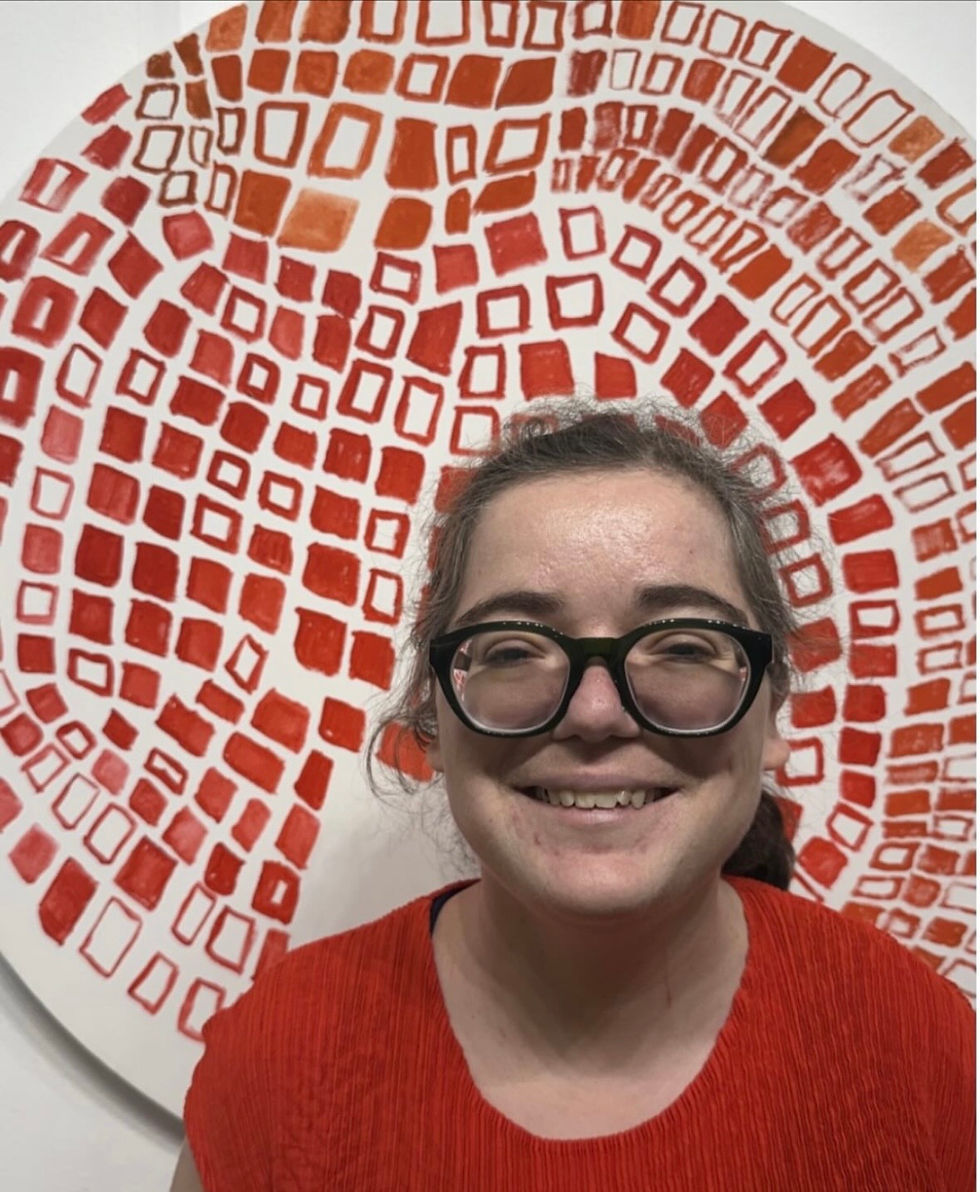
For Scarlett Lingwood, artistic exploration is an ongoing conversation between repetition and possibility, the individual and the collective, and the visible and invisible aspects of human experience.
From large-scale drawings and sound performances to colorful paintings and reimagined world maps, her work reflects an enduring curiosity about how people move through the world and connect with one another.
Her experiences across London, New York, and the wider international art community continue to shape a practice that embraces experimentation, uncertainty, and discovery.
Whether she is drawing repeated circles, imagining people dancing together during isolation, or reflecting on the relationships between public and private identities, Lingwood returns to the same fundamental curiosity: how can art help us better understand ourselves and the systems we share?
Through her thoughtful approach to mark-making, movement, and community, Scarlett Lingwood reminds us that even the simplest repeated gesture can open the door to something unexpected.
You can learn more about Scarlett Lingwood and her work via these links: Artsy: Scarlett Lingwood Instagram: @s.l.nyc
Comments