

Inside the Studio: Uchenna Obinabo-Mabazza

Uchenna Obinabo-Mabazza’s work begins in a place most people try to leave behind — the space between survival and uncertainty. His practice doesn’t emerge from theory or tradition, but from lived experience, where emotion arrives unfiltered and often unresolved.
What started as a private act of processing became something larger. His work carries the weight of illness, recovery, and the quiet, ongoing negotiation between fear and hope. Figures appear suspended, caught between rupture and renewal, holding tension rather than resolving it.
There is a physical honesty in the way his work is constructed — visible brushwork, fractured surfaces, and compositions that resist completion. Nothing is fully closed. Nothing is fully explained. Instead, the work invites the viewer into that same in-between space, where meaning is felt before it is understood.
Now extending beyond the studio through the Mabazza Foundation, his practice continues into real-world impact — connecting personal experience with broader conversations around healing, resilience, and emotional support.
In this Inside the Studio conversation, Obinabo-Mabazza reflects on survival, transformation, storytelling, and the role of art as both expression and offering.

Read on to learn more in an exclusive interview with Uchenna Obinabo-Mabazza:
Your artistic journey began in the context of a deeply personal experience with illness and recovery. How did art evolve from a private form of healing into a broader practice rooted in resilience, identity, and connection?
So to answer that question… it really didn’t start as an artistic journey at all.
After the Pancreatic cancer, after the surgeries, and everything that came with it, there was just a lot sitting there. A lot of emotion, a lot of things I hadn’t processed it was my (year from hell). At the same time, my life had completely changed. I had moved, started a new job, was living in a new place where I didn’t know anyone. It was just me, my spouse, and my dog. And if I’m being honest, life felt a little meaningless for a while.
So I did what most people do. I went to the doctor, got referred to a psychologist. That part didn’t really help much. But one thing they said stuck with me. They said I needed some way to express what I was holding in. Whether that was writing, talking to someone, something… it had to go somewhere.
That’s when I found Digital Art.
It gave me a way to take what I was feeling and actually see it. In the beginning, the images were very dark. A lot of blacks, deep blues, heavy, almost oppressive imagery. Skulls, shadows, things that reflected where I was mentally at that time.
And then I hit a point where I had a choice.
I could keep creating from that place, or I could try to shift. Not ignore what I went through, but start looking at things differently. The simple things. The sun coming through the window. Walking the dog. Flowers in the spring. Small moments that I wasn’t really seeing before.
I still have hard days. That doesn’t go away. Some days feel like a sad song. Other days feel lighter, somewhere in between, or even hopeful. And those shifts in feeling started to show up in the work too.
Over time, creating became a kind of therapy for me. A way to process everything without having to explain it all out loud.
Then it grew into something more.
After creating so many pieces, I started to realize this didn’t have to just stay with me. With my spouse, we decided to start the Mabazza Foundation.
The idea was simple. Take these works that came from real places, pain, healing, everything in between, and use them to help others.
Because one thing I learned during my cancer treatment is that even when you have the best medical care, and I did, the emotional side can still be missing. That part matters more than people realize.
So now the work is still personal, but it’s also about giving back. Supporting programs like Livestrong at the YMCA and others that provide that emotional support to people going through cancer and to their families.
That’s really how it evolved. It started as something I needed, and over time, it became something I could offer.

Your work bridges digital creation and traditional oil painting through collaboration. How do you navigate the transition from an internal, digitally conceived vision to a physically realized artwork, and what does that shift mean to you conceptually?
For me, the digital part is where everything starts. Especially because my memory isn’t what it used to be especially after chemotherapy, I need a way to capture a feeling right when it shows up. If I don’t, it can disappear just as quickly.
So I create in that moment. I get something down, not perfect, just honest. Then I come back to it later and refine it. Sometimes over days, sometimes over months. There are pieces I’ve revisited years later because they didn’t feel right yet.
One example is a piece inspired by the song Ashes by Celine Dion. The emotion in that song is very strong. It speaks to loss, but also to the question of whether something beautiful can come out of that loss. That line, “let beauty come out of ashes,” stayed with me for a long time.
I worked on that idea for about two years. I knew what it meant to me emotionally, but I couldn’t fully see it yet. And then one day, it finally made sense in my mind. I could see it clearly enough to create it in a way that felt true.
When I’m creating digitally, I’m not focused on perfection. I’m focused on the feeling. If something feels right, even if it’s a little off, I leave it. That’s usually where the honesty is.
Once I reach that point, I run it through what I call a Gallery Six analysis. That helps me decide if the piece is ready to move forward.
The shift happens when it becomes a physical painting.
At that point, it’s no longer just mine. There’s another person involved, another set of hands. I work with a painter, and the process becomes a kind of conversation. Not always spoken, but a back-and-forth between what I felt and how that feeling gets translated onto canvas.
Some things change in that process, and they should. Digital work can do things paint can’t, and paint can do things digital can’t. The texture, the depth, the way light sits on the surface, those are things you can only really experience in a physical piece.
Conceptually, that shift means a lot to me.
The digital image feels like a thought. It’s immediate. But the painting takes time. It slows everything down and brings it into the real world.
And in a way, that mirrors my own experience.
A lot of what I went through during and after cancer lived inside me for a long time. Turning those feelings into something physical, something that takes up space, is a way of making it real and something that can be shared.
It’s not just something I went through anymore. It becomes something that someone else can stand in front of and maybe feel something of their own.
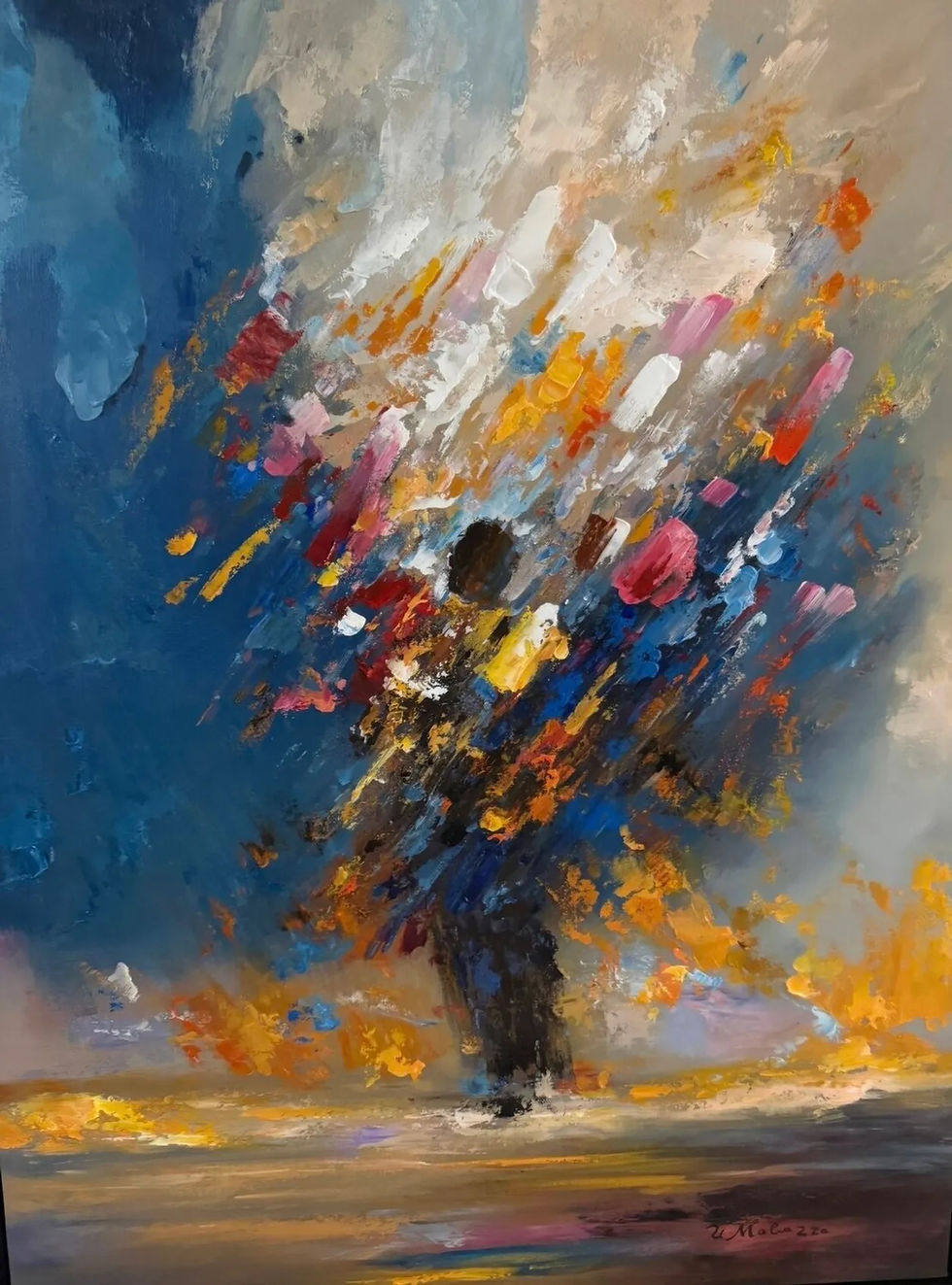
Many of your works explore the space between rupture and renewal, where figures feel suspended in transformation. What draws you to this emotional threshold, and how do you know when a piece has fully expressed that tension?
From a personal standpoint, I think I’m drawn to that space because I’m living in it.
I had pancreatic cancer. The odds are about a 6% survival rate. After surgery and chemotherapy, I was told my lifespan could be 10 to 12 years. So that leaves you in a very real “in between.”
In between what now, and what’s next.
Do I plan for dying, or do I plan for living?
After five years, am I halfway to the end, or am I just getting started?
That space… that’s where I exist.
There’s a lot of mental work that comes with that. Constantly trying to reframe, to not get pulled too far in one direction or the other. And I think that’s what draws me to this kind of imagery. It reflects that tension. Not fully broken, not fully healed, just suspended somewhere in the middle.
Visually, I lean on certain methods to express that. Contrapposto, where the body isn’t balanced but still standing. Thick impasto, where the surface carries weight and texture. Bent or strained physical forms. Deliberate brushstrokes that don’t try to hide themselves. Sometimes leaving parts unfinished, so the viewer has to meet the work halfway.
There’s also that Rückenfigur idea, the figure turned away, not fully revealed. And the use of light and shadow, pushing contrast, letting one side fall away while the other tries to emerge.
All of that helps hold that feeling of being in between.
As for when a piece is finished…
It’s not technical for me.
It’s emotional.
If I can look at it and it brings me back to the exact feeling I had when I started it, then I know I’m close. If it hits me in a way where I have to pause, or if I’m explaining it and I start to choke up a little, then I know it’s there.
That’s when I stop.
Not because it’s perfect, but because it’s honest.

As the founder of the Mabazza Foundation, your practice extends beyond the studio into community impact. How do you balance the roles of artist and advocate, and how does this mission shape the way you approach your work?
For me, being an artist and being an advocate aren’t separate identities competing for time. They are reflections of the same origin point. Everything begins with the experience I went through… the uncertainty, the fear, the quiet moments where you don’t know which version of your future is real. That space didn’t just shape me emotionally, it rewired the reason I create at all.
Before, when I thought of art it existed on its own. Now, it has a responsibility.
The Mabazza Foundation gave that responsibility a structure. It took something deeply personal and turned it outward. So the question is no longer “what do I want to make?” but “what does someone else need to feel when they stand in front of this (the finished artwork)?”
That shift changes everything.
It influences:
• Subject matter → figures that feel suspended, not finished, not resolved
• Technique → visible brushwork, fractures, areas left incomplete so the viewer can enter
• Emotion → work that holds tension, but never removes the possibility of light
There are days when I’m working on a grant, or coordinating with a community partner, or planning how a piece will function in a fundraising space, and it might look like I’ve stepped away from being an artist. But I haven’t. That is the work now.
Because the artwork doesn’t end at the canvas anymore.
It continues in the room where it’s shown.
In the person who connects to it.
In the program it helps fund.
In the conversation it starts.
So the balance becomes less about dividing time and more about maintaining alignment. I ask myself one question constantly:
Is this still coming from a place of truth… and is it still reaching someone beyond me?
If the answer is yes, then both roles are being honored at the same time.
In a way, the studio and the community are just two ends of the same bridge. One side is where the emotion is formed. The other is where it finally arrives.

Light, shadow, and depth play a powerful role in your compositions, often creating a sculptural, almost cinematic presence. How do these visual elements help you convey themes of endurance, vulnerability, and hope?
Light and shadow are not just visual tools for me, they’re the emotional architecture of the piece… almost like the unseen script the figure is living inside
I think of light as permission and shadow as truth.
The shadow is where everything honest lives. It holds the weight, the fear, the uncertainty, the parts of the body and spirit that aren’t resolved. When I deepen those areas, when I let parts of the figure fall away into darkness, I’m not hiding them. I’m acknowledging that some experiences don’t fully reveal themselves, especially in moments of endurance. There’s always something carried quietly.
But the light… the light is intentional.
It doesn’t flood the scene. It finds the figure. It selects what deserves to be seen. Sometimes it lands on the chest, sometimes the face, sometimes just the edge of a shoulder or a hand. And that placement becomes everything. It’s where I place hope, but not in an obvious way. It’s more like a quiet insistence that something is still alive, still reaching.
Depth is what allows those two forces to breathe.
Through contrast, layering, and spatial falloff, the figure begins to feel suspended in a real emotional space rather than just a painted one. That’s where vulnerability enters. When a body feels dimensional, grounded, almost sculptural, it becomes harder to look at it as an image and easier to recognize it as someone. And once that happens, the viewer brings their own story into the work.
Cinematically, I’m always thinking about that single frame where everything is held in tension… not before, not after… but right in the middle of becoming.
That’s where endurance lives.
Not in collapse. Not in resolution.
But in that suspended moment where the figure hasn’t turned away, hasn’t given up, is still standing within the contrast of shadow and light.
So the composition becomes a kind of quiet negotiation:
Shadow says: this is what you carry
Light says: this is what remains
And somewhere in between those two… is where hope begins to take shape.

Your work often carries a quiet intensity — emotional, yet restrained. How do you approach storytelling in a way that invites reflection without overwhelming the viewer?
Visual storytelling is what painting is. But I’ve wrestled with what that responsibility means.
Do I create something simply beautiful… a field of flowers, a calm landscape that lives comfortably on a wall… or do I bring forward the weight of lived experience, the darker emotional truths that come from surviving something most people never have to face? And if I do that, who wants it? Why would someone choose to live with that on their wall?
There has to be an in-between.
That’s where my work lives.
I don’t believe in overwhelming the viewer. I believe in inviting them. One of the ways I do that is through structure, often using a triangular composition. It gives the eye a path… three points to move between. And in that movement, something happens. The viewer begins to ask: what else is here? what am I missing? what comes next?
The story doesn’t announce itself. It reveals itself slowly.
A piece has to have what I call an “across the room pull.” Something that brings you in before you even understand why. In The Weight of Heaven, it’s the mountain. Its scale. Its presence. It holds the entire painting in place.
Then, as you move closer, the details begin to speak. The diagonal rain cutting across the surface. And anyone who has walked through that kind of rain knows… it doesn’t just fall, it strikes. It carries force. It wears you down.
And then you see him.
A small figure, halfway up. Still moving.
That’s where the painting stops telling you what to think… and starts asking you to decide, where are they going? What is their journey?
Is he halfway to the end?Or halfway through something he’s about to overcome?
That space… that unanswered question… is where the viewer enters the work.
I’ve always believed, much like Marcel Duchamp suggested, that the work isn’t finished by the artist alone. The viewer completes it. Not by decoding it, but by bringing their own weight, their own experience, into it.
So the restraint is intentional.
I don’t give the full story because the most important part of the story doesn’t belong to me. It belongs to the person standing in front of it.
And if I’ve done it right, they don’t just look at the painting…
They step into it.

You presented your work at Clio Art Fair in New York as part of the September 18–21 edition. What was that experience like for you, and how did engaging with an international audience shape your understanding of your work and its impact?
Clio Art Fair in New York was unforgettable. My first NYC show, and stepping into that space felt like crossing into a different level of the art world.
My work was exhibited alongside an incredible range of international artists… from a creator blending mixed media with video game design, to a world-renowned photographer preparing to leave for Europe that same week, to the legacy of “Atom,” presented by his parents post mortem.
To be placed among artists whose works ranged from $800 to $140,000 was surreal. It wasn’t just an exhibition… it was an education.
And what made the experience even more meaningful was how seamlessly it was handled. The Clio team created an environment where, as an artist, I could simply arrive, install, and be present. That allowed me to focus fully on the work and the people engaging with it.
What stayed with me most, though, was the shift in how I understood my own presentation.
Going into the show, I approached it with the mindset of variety… bringing different styles, different ideas, a little something for everyone. But being in that space, and watching how people moved through the gallery, changed that perspective completely.
I realized that in a gallery setting, cohesion matters just as much as individual impact.
An audience doesn’t reset between paintings. They carry what they’ve just seen into the next piece in a set. When the work is too varied within a space, it interrupts that emotional continuity. It doesn’t allow the viewer to settle, to reflect, or to go deeper.
That experience pushed me toward working in series.
Now, I think in terms of building a visual conversation… a central “hero” piece supported by surrounding works that extend, echo, and deepen the narrative. Whether it’s florals, landscapes, or impasto figurative work, each piece becomes part of a larger story rather than a standalone moment.
And engaging with an international audience reinforced something even more important… that emotion translates.
I remember one interaction in particular. I was speaking with a woman about a piece featuring moonlight and lilies, sharing the story behind it, the emotional weight it carried for me. And without hesitation, she understood. Immediately. No explanation needed beyond a few words.
That moment stayed with me.
Because it reminded me that while the work begins in something deeply personal, it doesn’t stay there. It reaches outward. Across cultures, across experiences, across completely different lives.
Clio didn’t just show me where my work fits…
It showed me how it can connect.

Through both original works and limited edition prints, your art reaches a wide and diverse audience. How do you think about accessibility versus uniqueness, and what role does each play in your overall vision?
I think about it less as a tension… and more like two different doorways into the same room.
Accessibility and uniqueness aren’t competing ideas for me. They’re part of the same intention… which is connection and a way to help others going through the same journey of recovery.
The original works carry something that can’t be replicated. There’s a physical presence to them… the weight of the paint, the texture, the small imperfections, the decisions that only exist in that one moment of making. They hold the full emotional imprint of the process. For a collector, that matters. It’s not just owning an image, it’s holding a singular experience.
But not everyone encounters the work in that way… and I don’t believe they should have to.
That’s where accessibility comes in, through limited edition prints. Not as a secondary version, but as an extension. A way for the work to live in more spaces, with more people, without losing its intention. The goal is never to dilute the piece, but to preserve its emotional clarity while allowing it to travel further.
Because the mission behind the work… especially through the Mabazza Foundation… is rooted in reach.
If a piece is about endurance, about vulnerability, about that quiet space of “in between,” then it shouldn’t only exist in a single collector’s home. It should be able to sit in a place where someone who needs it can encounter it unexpectedly. A hallway, a living room, a community space… somewhere it can meet someone at the right moment.
At the same time, uniqueness anchors the work.
The original pieces set the tone. They define the standard, the depth, the intention. They’re the source. And everything else flows from that.
So the balance becomes intentional:
• Originals hold the full, singular weight of the experience
• Limited editions allow that experience to extend outward
One is about presence.
The other is about reach.
And together, they support the larger vision… which isn’t just to create something beautiful, but to create something that can be felt by as many people as possible, without losing where it came from.

Obinabo-Mabazza’s work doesn’t separate experience from expression — it carries it forward.
The longer you stay with his work, the more it reveals itself: tension held without resolution, figures suspended without collapse, emotion present without excess. Nothing is forced. Nothing is overstated. Instead, the work remains open, allowing the viewer to meet it from their own place.
What lingers is the space he creates — between endurance and vulnerability, shadow and light, uncertainty and possibility.
His work does not try to resolve these tensions. It holds them.
And in doing so, it offers something rare — not answers, but connection.
You can learn more about Uchenna Obinabo-Mabazza and his work via these links:
Website: Mabazza Foundation Instagram: @mabazza_foundation
Facebook: @Uchenna Obinabo-Mabazza
LinkedIn: @Uchenna Obinabo-Mabazza
Comments