

Inside the Studio: Yi-Chiao Chen

Yi-Chiao Chen paints in a state of transition. Her works don’t settle into fixed forms — they unfold through layers of movement, energy, and transformation, where each image feels in the process of becoming rather than arriving.
Fluid gestures, shifting densities, and recurring elements like water and light create spaces that feel both grounded and intangible. Forms emerge, dissolve, and reappear, holding a tension between clarity and ambiguity that resists final definition. There is a quiet instability within the work — a sense that what is visible is only one moment within a larger, continuous cycle.
Rather than constructing images with fixed meaning, Chen approaches painting as a way of translating something less tangible: emotion, memory, and what she describes as invisible energy. Through repetition, layering, and subtle shifts in color and form, her work builds an atmosphere that invites viewers to engage slowly, moving between recognition and uncertainty.
Working between the personal and the universal, Chen develops a visual language that is both intimate and expansive. Her paintings don’t ask to be decoded — they ask to be experienced, allowing meaning to emerge gradually through presence, perception, and time.
In this Inside the Studio conversation, Chen reflects on self-ignition, invisible energy, motherhood, and the balance between tradition and transformation.

Read on to learn more in an exclusive interview with Yi-Chiao Chen:
Your work often speaks about art as a continuous process of “self-ignition” — a cycle of becoming rather than a fixed outcome. How has this idea shaped your artistic journey, and the way you approach each new body of work?
My practice is rooted in the idea of “self-ignition” as an ongoing process rather than a fixed outcome. Each body of work begins not with a conclusion, but with a state of sensitivity—an openness to internal and external shifts. Over time, I have come to understand painting as entering a continuous cycle of becoming. This allows each series to evolve organically, where meaning is not imposed but gradually revealed through repetition, layering, and transformation.

You describe your practice as an exploration of invisible energy — something both deeply personal and universal. How do you translate something so intangible into a visual language that viewers can feel and connect with?
I approach painting as a way to translate invisible energy into a tangible experience. This energy is both deeply personal and universally resonant—it emerges from memory, emotion, and lived experience, yet also extends beyond language. Through layered pigments, fluid gestures, and shifts in density, I create visual fields that invite viewers to feel rather than simply interpret. The work becomes a space where the invisible is not explained, but embodied.

You exhibited at Clio Art Fair in New York, where your work was recognized for its sense of resilience and adaptability. What was that experience like for you, and how did engaging directly with an international audience shape your perspective on your practice?
Exhibiting at Clio Art Fair in New York was a significant moment of reflection. Presenting my work within an international context allowed me to see how my visual language could resonate across different cultural backgrounds. What stood out was how viewers responded to the emotional and energetic qualities of the work, even without shared references. This reinforced my belief that abstraction can function as a universal language, and encouraged me to further refine a practice that is both personal and outward-reaching.
Installation view of Yi-Chiao Chen’s booth at Clio Art Fair 20th Edition Yi-Chiao Chen, 21st-Century Madonna and Child – Love is Weight but it is Sweet, 2019 Oil on canvas Yi-Chiao Chen with a guest at Clio Art Fair 20th Edition, in front of her exhibited works
Water appears repeatedly in your work as both a symbol and a structure — fluid, transformative, and constantly in motion. What draws you to water as a central motif, and how does it reflect your understanding of transformation and time?
Water appears in my work as both a visual structure and a conceptual foundation. I am drawn to its fluidity—its ability to transform while maintaining its essence. It reflects my understanding of time not as a linear progression, but as a continuous flow. In my paintings, water becomes a metaphor for states of transition, existing between stability and movement, presence and dissolution.
Your paintings often exist in a space between clarity and ambiguity — where forms feel familiar yet remain unresolved. How important is this tension between the known and the unknown in your work?
The tension between clarity and ambiguity is essential to my work. I am interested in creating forms that feel familiar, yet resist complete definition. This space of uncertainty invites viewers to remain engaged, navigating between recognition and imagination. Rather than offering fixed meanings, the work opens a field of possibilities where interpretation remains fluid and evolving.

Blue and gold play a powerful role in your compositions, often carrying emotional and spiritual weight. How do these colors function within your work, and what do they allow you to express that form alone cannot?
Blue and gold function as more than color choices in my work—they carry emotional and spiritual weight. Blue evokes depth, stillness, and introspection, while gold introduces light, energy, and transformation. Together, they create a dynamic balance between the internal and the external, the material and the immaterial. Through color, I am able to express dimensions of experience that form alone cannot fully convey.
Your concept of the “Cosmic Mother” expands motherhood beyond the personal into something universal and energetic. How has your experience of motherhood influenced your artistic language and the themes you explore?
The concept of the “Cosmic Mother” expands from my personal experience of motherhood into a broader, universal framework. For me, motherhood is not only a biological or social role, but a state of creation, protection, and transformation. This perspective informs my artistic language, where organic forms, layered structures, and cyclical processes reflect a larger system of life and regeneration. It allows the work to move beyond autobiography and connect with collective human experience.

In your “21st-Century Madonna and Child” series, you reinterpret historical iconography through an Asian and contemporary lens. How do you approach balancing tradition with transformation when working with such deeply rooted cultural symbols?
In my “21st-Century Madonna and Child” series, I approach historical iconography as a living language rather than a fixed tradition. I am interested in how these deeply rooted symbols can be reinterpreted through a contemporary and culturally situated perspective. By shifting forms, materials, and context, I seek a balance between continuity and transformation—honoring the historical resonance while allowing it to evolve into something relevant to the present.
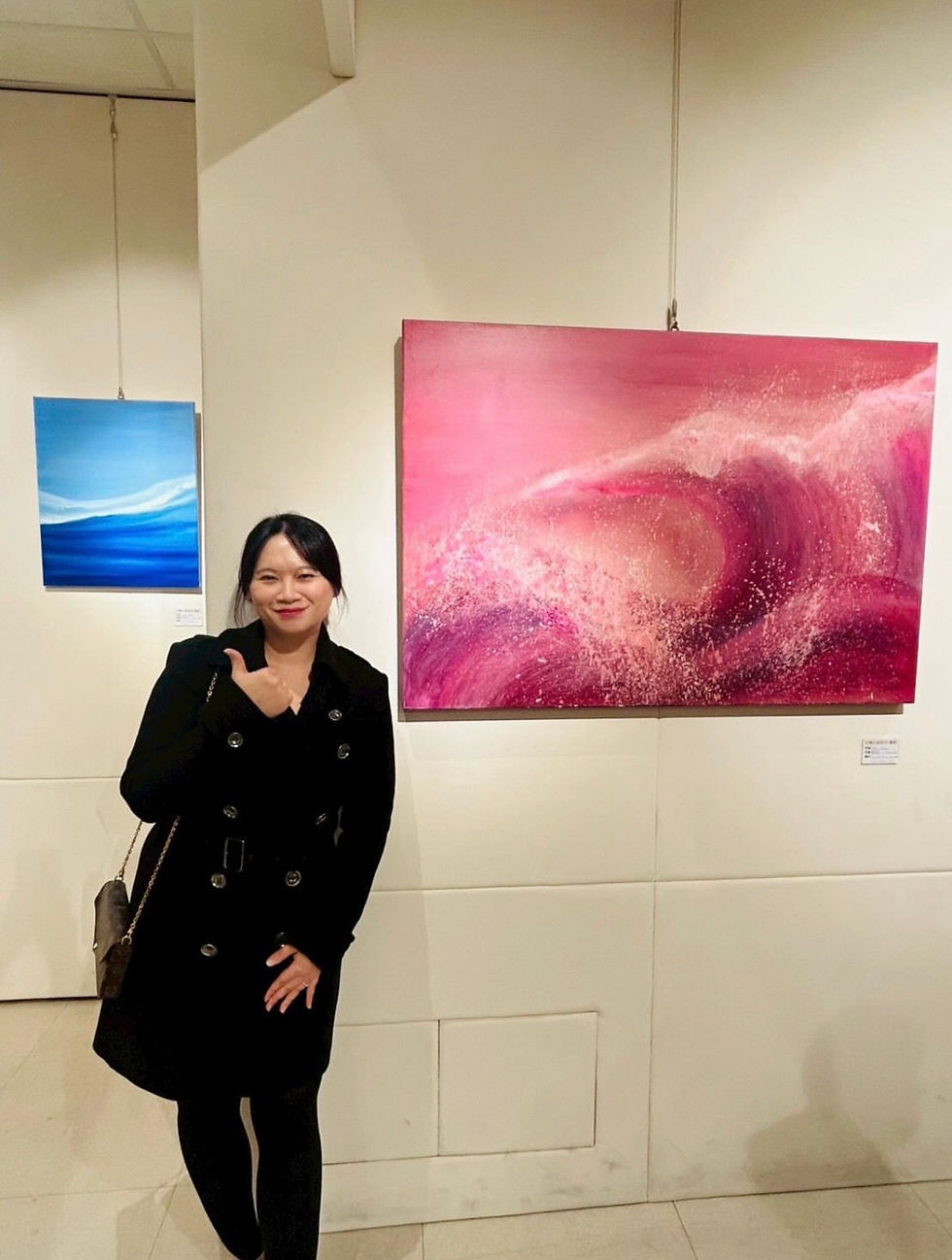
Chen’s work doesn’t arrive at conclusions — it remains in motion, holding space for change rather than resolution.
The longer you stay with her paintings, the more they shift: structure into flow, image into sensation, clarity into ambiguity. What first appears as form begins to dissolve into something more atmospheric, more emotional, more difficult to define. This constant movement becomes central to the experience, drawing the viewer into a slower, more attentive way of looking.
What lingers is the balance she sustains — between the visible and the invisible, the personal and the universal, the material and the immaterial. Her work moves between these spaces without settling, allowing each element to remain open, in dialogue, and in flux.
Rather than offering fixed interpretations, Chen creates a field of possibilities. Meaning is not presented all at once, but unfolds over time, shaped by the viewer’s own presence and perception.
Her paintings don’t define what is seen — they create the conditions for something to be felt, remembered, and continuously reimagined.
You can learn more about Yi-Chiao Chen and her work via these links:

Website: Yi-Chiao Chen Instagram: @yichiaochen_art
Facebook: @Yi-Chiao Chen
Comments